Cost Per Transaction in Corporate Travel: The Metric That Reveals Whether Your Program Is Working
Learn how to calculate cost per transaction by booking channel, benchmark mid-market fees, and build a CFO-ready business case for your travel program.


Your TMC invoice arrives every month with line-item fees, but a single question keeps surfacing in quarterly reviews: what does it actually cost to process each booking through the program? When your CFO asks why managed travel costs are climbing while headcount stays flat, a blended cost per transaction number won't hold up. You need the metric broken out by channel.
This article covers four areas that turn cost per transaction into a working metric: how to calculate it accurately, what mid-market benchmarks look like, what call-in drivers matter most, and how to frame the business case for leadership. You'll walk away with the calculation, the benchmarks, and a framework to defend program spend to your CFO.
How to Calculate Cost Per Transaction at the Program Level
Cost per transaction is what your company pays to process a single travel booking. The inputs include:
- Direct TMC fees, split by online and agent-assisted channels
- OBT licensing or per-transaction fees
- Internal labor required to manage bookings through the program
At the program level, a broader version of this metric is Cost of Managed Travel: total travel program costs divided by total travel spend. That formula adds buyer FTE labor, data and reporting fees, consulting fees, and other program overhead. Cost per transaction by channel is the more actionable starting point because it ties directly to booking behavior you can influence.
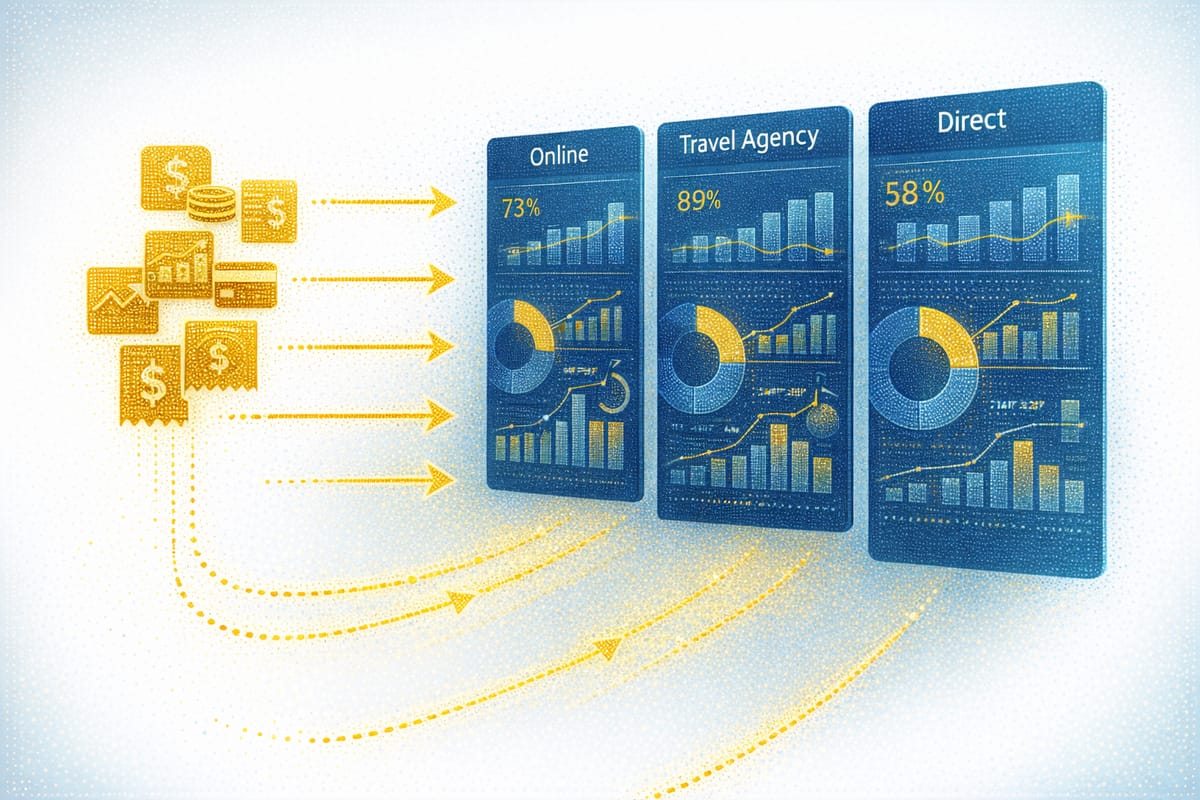
The calculation breaks when you don't segment by channel. Blending online and agent-assisted transactions into a single average hides the cost gap that matters most. Online transactions run below agent-assisted transactions across public benchmarks, so without segmentation, a program running 60% online and 40% agent-assisted looks identical to one running 80/20, even though the second program pays less per booking. The same logic applies to growing programs that lack historical TMC reporting, because even rough segmentation by booking method reveals where spend concentrates and where cost reduction starts.
What Mid-Market Programs Actually Pay by Booking Channel
The fee differential between online and agent-assisted bookings is the single most actionable data point in transaction cost analysis. Public TMC fee benchmarks show a wide range across booking types and channels, from $5 for a hotel or car reservation booked online to $35 for an international flight booked through an agent at the published extremes. Offline transactions remain more expensive than online transactions across every public benchmark.
For mid-market programs specifically, the picture is usually worse, not better. Lower booking volume pushes unit costs up, which means programs in the 200-2,000 employee range often pay at or above published fee benchmarks. Federal contract pricing data reinforces that pattern, showing a meaningful online-versus-agent gap even in government contract pricing. That transaction cost gap scales across every booking in your program. Once you know how many transactions route online versus to an agent, you can tie fee schedules to actual booking behavior and identify where the fulfillment cost reduction opportunity sits.
Why Travelers Call In and What It Costs Per Transaction
Call-in volume is the fastest way to inflate cost per transaction, and the root causes are usually program design problems, not traveler behavior problems. Diagnosing before treating matters, because communication campaigns don't fix content gaps, and policy mandates don't fix UX friction.
Content and Inventory Gaps
When the OBT doesn't display the airlines, hotels, or fare options travelers need, they search outside the program. Supplier content, including ancillaries, seat selection, and rich product details, is often richer on airline direct sites than in corporate booking tools, and these content gaps remain a persistent issue. Price discrepancies between OBT results and what travelers find on consumer sites erode channel trust, and once that trust is gone, it doesn't come back after one good search result. The fix starts with auditing which suppliers travelers book outside the OBT and verifying whether those options exist in the tool. Where the gap traces back to NDC distribution, the content problem sits between your TMC and the airlines, not between your travelers and the portal.
UX Friction and the Consumer Experience Gap
Travelers accustomed to consumer booking sites abandon legacy corporate systems that feel slow, restrictive, or require too many clicks. The calculation is rational: if booking through the OBT takes longer than calling an agent, they call. Each call converts what should have been a low-cost online transaction into a higher-cost agent-assisted one.
That friction gap is where Otto the Agent fits. Otto handles booking requests conversationally and routes them through your existing TMC, so travelers complete managed bookings without navigating the OBT step by step. The booking still processes through managed channels at online transaction cost, but the traveler neverhits the friction that would have driven a call-in. And in the rare cases where a traveler does need human support, Otto provides free 24/7 phone assistance, so even that edge case stays within the managed program.
When friction and policy clarity are both part of the problem, the question isn't whether travelers find the experience convenient. It's whether the booking path captures more compliant online transactions, because that is what moves the cost-per-transaction number.
Structural Complexity That Routes to Agents by Design
Not all agent-assisted transactions represent adoption failures. Multi-leg domestic itineraries with more than three destinations and international bookings are standard candidates for agent handling. Separating these structural agent transactions from avoidable call-ins is essential because it shows the true cost reduction opportunity.
The distinction matters when you build a business case. If a quarter of your agent-assisted volume is structurally complex, the addressable call-in volume is the remainder. Treating the full agent-assisted number as the opportunity overstates the savings and undercuts credibility with finance.
Turning Cost Per Transaction Into a CFO-Ready Business Case
Channel shift savings are the strongest opening metric for a finance conversation because they require zero assumptions. The calculation uses contracted fee schedules and booking system records, both of which finance teams can verify independently. 78% of travel buyers rank cost control as a top strategic priority, and cost per transaction by channel gives you the unit economics to back that up.
The framework works in three layers, each connected to the transaction cost story:
- First, present program cost efficiency through cost per transaction by channel and OBT adoption rate. This is the foundation: it shows what each booking costs today and how channel mix drives the number.
- Second, show where booking costs hide outside the program. Policy compliance rate and program leakage rate matter here because bookings that bypass the managed program entirely never appear in your channel cost data. Air and hotel leakage both contribute to this gap, inflating true cost per booking while making the reported number look artificially stable.
- Third, connect transaction cost visibility to broader program value through duty of care coverage and spend visibility percentage. If bookings route outside the program to avoid friction, you lose not only the cost advantage of online transactions but also the traveler tracking and spend data that justify the program to begin with.
Data credibility matters more than completeness when presenting to finance leadership. Get CFO staff input early, begin with simpler ROI frameworks before complex calculations, and build trust in the data before expanding scope. That approach separates a travel manager defending a budget from one demonstrating strategic value.
Make Transaction Costs Visible Before They Distort Program ROI
Cost per transaction by channel turns a vague "costs are rising" conversation into a specific one about where bookings route and what each route costs. That specificity is what gives you standing to act, whether the next step is an OBT content audit, a TMC fee renegotiation, or a new booking path that reduces friction-driven call-ins.
Otto fits that last category. Because it already routes requests through your existing TMC at online transaction cost, adding it to the program shifts channel mix without replacing any infrastructure. Your TMC relationship and duty of care coverage stay intact while the agent-assisted volume that inflates your fulfillment costs drops.
Sign up for Otto to reduce call-in volume and shift your channel mix toward lower-cost online transactions.
FAQ
What counts as a transaction when calculating cost per transaction?
A transaction typically includes airline tickets issued or purchased, with some TMC arrangements billing separately for hotel-only and car-only reservations, refunds, exchanges, and cancellations. The definition varies by contract, so confirm with your TMC which booking events trigger a billable transaction before running any calculations.
How do I benchmark OBT adoption when mid-market data is limited?
Publicly available OBT adoption benchmarks broken out by company size, especially for the 200-2,000 employee range, remain limited. The most direct path is to request anonymized program benchmarking from your TMC account team or use GBTA member research where available. For general context, not every booking is structurally suitable for online completion, so segmenting eligible transactions first gives you a more defensible target.
How can I reduce TMC call-in volume without adding friction for travelers?
Start by identifying which calls come from content gaps, which come from poor booking flow, and which are structurally agent-only transactions. For friction-driven call-ins, a conversational AI layer like Otto can route booking requests through your existing TMC without requiring travelers to navigate the OBT directly, shifting those transactions from agent-assisted cost to online cost.
Why do TMCs have limited incentive to help me improve online adoption?
Agent-assisted transactions generate higher per-transaction revenue for TMCs than online bookings. That makes online adoption a metric you need to manage directly through your fee structure, reporting cadence, and service expectations. If channel shift matters to your program economics, put adoption targets and reporting requirements into your TMC review process.