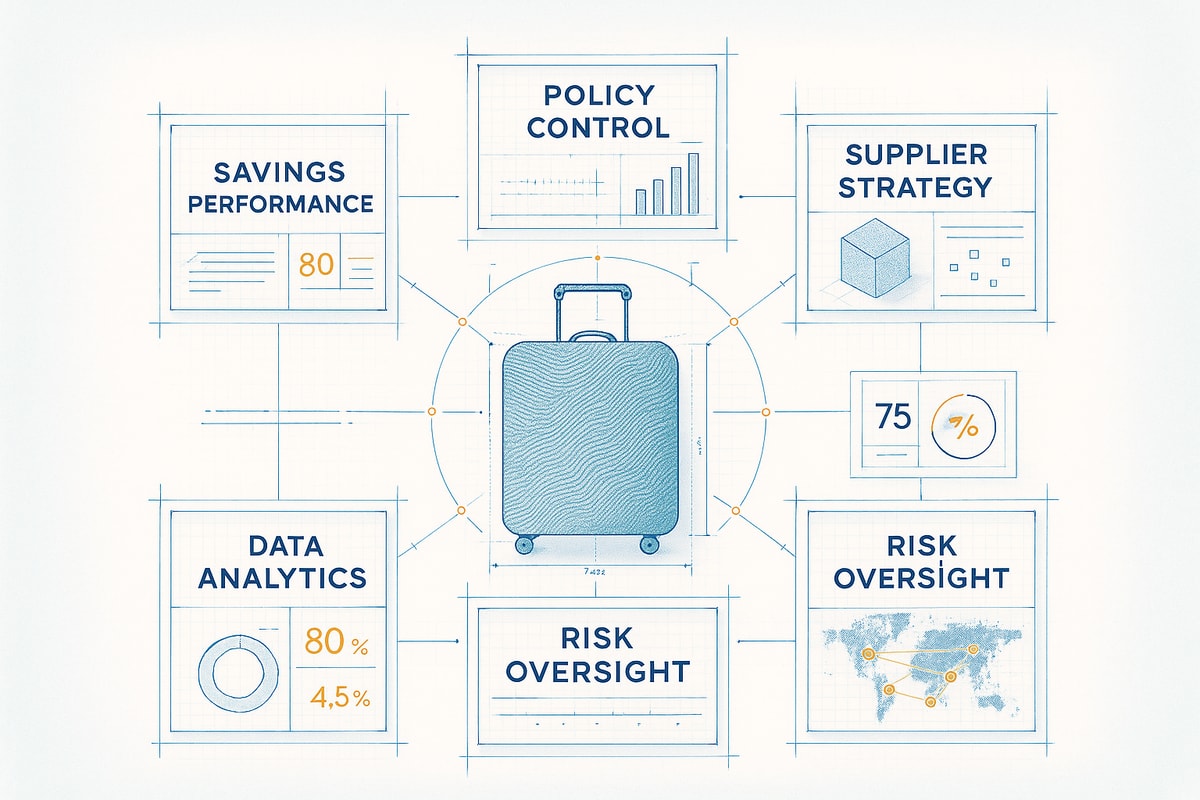
Top Corporate Travel Management Companies: What to Compare Beyond the Sales Deck
Go beyond the sales deck. Compare top corporate TMCs on service model fit, fee structure, and mid-market account treatment before your next RFP.


Your TMC's quarterly business review shows strong fulfillment metrics, but your transaction costs tell a different story. Agent-assisted bookings keep climbing, OBT adoption hovers below 50%, and finance wants to know why you're paying more for managed travel than you did two years ago. The problem isn't that you picked the wrong TMC. It's that the criteria most travel managers use to evaluate top corporate travel management companies don't account for what drives program performance.
This guide breaks down four dimensions that separate the best travel management company options in practice, not in pitch decks, so you can evaluate whether your current partner still fits your corporate travel program and build a shortlist grounded in outcomes.
Where the Major TMCs Actually Differ
The list of corporate travel management companies looks different after the Amex GBT-CWT merger closed in September 2025. That deal created a combined entity with roughly $45.5B in 2024 sales, based on merger data. The consolidation kicked off a wave of RFP activity, with more than two-thirds of mid-market stakeholders actively seeking TMC alternatives.
Technology ranks as the top factor when travel managers select a TMC, yet many of those same managers call it a top pain point with their current provider. That gap reveals the core evaluation problem: what a TMC shows you during the sales process and what it delivers after signing are often different. When the delivered technology underperforms, adoption suffers, which is why OBT guides alone rarely fix adoption if the booking experience still creates friction.
The right travel management company for a mid-market program depends on service model fit, not brand recognition. TMCs cluster into three distinct approaches.
Software-Led TMC Platforms
Some TMCs lead with unified technology stacks where the OBT, reporting, and expense tools share a single interface. The pitch is consolidation: fewer vendor relationships, one data source, integrated workflows. But that consolidation comes at the cost of flexibility. When the platform doesn't support a workflow your program needs, the workaround is usually manual.
Analytics-Driven TMC Models
BCD pairs DecisionSource with open OBT integrations, and CTM combines dedicated account teams with the Radius network. These TMCs compete on data depth and configurability rather than a single-platform experience. The strength is adaptability to existing program structures, but open architecture requires more active management from your side.
Service-Driven TMC Models
FCM layers its AI assistant "Sam" onto a relationship-driven model, and Christopherson uses proactive outreach at key booking points. Both bet that agent quality and responsiveness drive retention better than technology alone. That model works when travelers need high-touch support, but it can entrench call-in behavior that raises transaction costs over time.
Each model produces different outcomes for adoption, fulfillment costs, and duty of care. The question isn't which TMC is biggest. It's which service model matches how your travelers book.
TMC Transaction Fees Behind the Headline Number
Transaction-based fees remain the dominant pricing model, charged per transaction. But the headline rate hides the cost structure that actually determines your managed travel program economics.
The fee for a phone booking with an agent runs significantly higher than an online transaction, and those offline transactions are highly profitable for TMCs. That profit margin is exactly why some TMCs offer cheap online transactions as a loss leader to pull in more offline volume.
That differential is where program savings live or die. Factor in fully loaded costs, including agent time, queue handling, and quality checks, and a call-in transaction can run multiples of a self-service booking. Every traveler who calls instead of booking online widens that gap.
Otto the Agent targets that cost gap directly. Otto handles booking requests conversationally and routes them through managed travel infrastructure via TMC partners like Direct Travel and Spotnana. Travelers who would otherwise call an agent get instant responses without learning a new portal, which moves their transactions from the agent-assisted column into the online column and shrinks per-booking costs accordingly.
Apart from Otto's role in reducing those costs, your TMC's full fee schedule deserves close scrutiny on its own. Beyond the base rate, that schedule typically includes air transaction fees, car or hotel reservation fees, cancellation or refund fees, and after-hours service fees. Hidden triggers add up fast, which is why you should require a fully itemized cost schedule covering every fee trigger during evaluation, not just the per-transaction rate. That review should sit alongside broader savings strategies analysis, because transaction fees often erase supplier savings faster than teams expect.
How Mid-Market Accounts Get Treated Differently
Market-level service scores can look acceptable while mid-market programs get a thinner version of the same model. The gap shows up in three areas:
- Service teams and agent access. TMCs operate service models ranging from onsite dedicated teams for enterprise accounts to hybrid models with dedicated offsite agents to shared offsite service pools. Mid-market accounts default to shared pools, which means less agent continuity and lower priority during high-demand periods. Each major TMC draws its own line between mid-market and enterprise, and most programs under $25M in air spend fall into the smaller tier.
- Account management depth. The largest TMCs may not deliver the same account support to smaller programs compared with global enterprise clients. That translates to slower escalation paths, less proactive reporting, and fewer strategic reviews per year.
- Content and rate access. Mid-market accounts typically get consortia rates, not direct bilateral contracts negotiated from company volume. That content opacity makes compliance rules harder to enforce, because travelers compare managed options against what they think they saw elsewhere and assume the program is missing content.
How to Build a TMC Shortlist That Survives Implementation
Before contacting any vendor, answer four questions internally: Do you need global or domestic coverage? Does your program size warrant a mega-TMC or a regional specialist? What TMC-delivered technology matters most? What level of account management do you need?
From there, the shortlist-building process should follow a specific sequence:
- Run an RFI before the RFP. Determine whether a TMC meets minimum criteria before investing in a full evaluation.
- Conduct pre-RFP conversations. TMCs need to understand your program before they can propose against it. Blanket RFPs produce generic proposals that don't reflect what your account would actually receive.
- Require named account teams during the process. Service teams, not the sales team in the room, determine your program outcomes.
- Build a weighted scorecard before receiving responses. The critical failure mode in TMC selection is weak review methods rather than relying on intuition.
- Check references the TMC didn't curate. Ask for the full client list in your spend range and call recent departures for the most candid feedback.
For companies evaluating global options, verify the delivery model behind the coverage map. No global travel management company owns all its offices outright. Ask how data consolidates across regions and what happens contractually if a network partner exits.
One dimension most shortlists miss is OBT adoption rates for comparable clients. Ask each finalist for adoption metrics from clients with a similar booking mix. Then ask a second question most TMCs would rather not answer: what reduces call-in demand after go-live? In many programs, the answer isn't another portal feature. It's removing friction at the point of request entirely. Otto fills that role by intercepting booking requests before they become phone calls, keeping them in managed channels without forcing travelers through another login.
Evaluate TMCs on What Happens After Implementation
Picking the right TMC matters, but it doesn't fix the adoption gap that drives up transaction costs on its own. You can negotiate the best fee schedule, select the right service tier, and build a weighted scorecard, and still watch call-in volume climb because the booking experience creates friction travelers won't tolerate.
Otto closes that gap by giving travelers a conversational booking experience that keeps requests in managed channels. Set up Otto to cut agent-assisted booking volume and make your TMC investment deliver the program economics finance expects.
FAQ
What's a reasonable transaction fee benchmark for mid-market programs?
The headline number matters less than the blended cost per booking across your online and offline mix. A program with 60% adoption pays a very different effective rate than one at 40%, even on the same contract. Focus on total fulfillment cost divided by total transactions, and include after-hours charges, cancellation fees, and technology licensing before comparing vendors.
How long does a TMC RFP process take from start to finish?
Allow TMCs at least one month to respond to a domestic RFP, and longer for global programs. Budget four to six weeks for evaluation plus negotiation. The full process typically runs four to six months.
How can I reduce agent-assisted booking volume without adding friction for travelers?
The root cause is usually OBT friction, not traveler behavior. An offline booking can reflect a tool failure where the OBT didn't support what the traveler needed or threw an error. Otto reduces call-in pressure by letting travelers book conversationally and routing those requests through integrated TMC partners, so bookings stay managed without requiring a portal login.
Should mid-market companies choose a mega-TMC for broader coverage?
Not necessarily. An organization doesn't need a mega agency for broad geographical reach. Several TMCs operate multinationally through partner networks like Radius or consortia like GlobalStar. Mid-market accounts may find non-mega TMCs more attentive.
What should I look for in a TMC's duty of care capabilities?
Focus on data completeness, not technology claims. Ask what percentage of bookings generate complete traveler location data for clients with a similar booking mix, verify whether the risk intelligence partner is included in the base contract or priced as an add-on, and confirm how the TMC handles duty of care for bookings made outside managed channels, since 67% of travel managers report air leakage held steady or grew over the past year. If duty of care gaps are tied to out-of-channel behavior, review them alongside broader program friction rather than treating risk as a standalone tool question.