Business Car Rental: What Companies Actually Get
What a business car rental account delivers, what the discount excludes, and the charges that set the total.


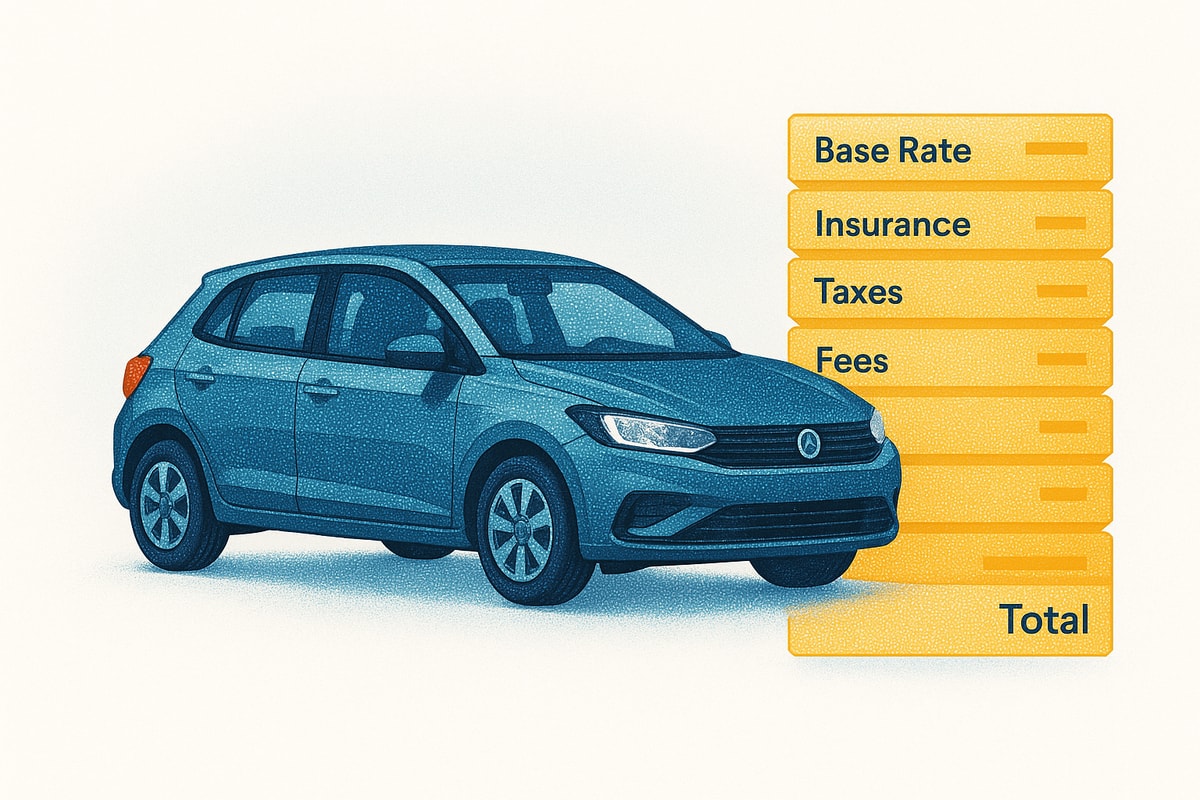
You opened a business rental account for the advertised discount. Then the first invoice landed close to the public rate. The supplier applied the discount to the daily time and mileage charge, one line on a bill that also carried airport fees, surcharges, and taxes at full price.
This guide covers five areas: what the account includes, what the discount reaches, what your rental volume qualifies you for, the charges that set the total, and where the records end up. You will be able to judge whether an account is worth opening and control the costs a negotiated rate never touches.
What a Business Car Rental Account Includes
Programs differ by supplier and by contract, but the benefits cluster into four categories. Only one of them is the rate.
A Discounted Base Rate Tied to a Code
Enrollment gets you a discount code, not a custom price. Hertz assigns a corporate discount number when a business registers, and employees enter it at booking to apply the negotiated rate. That code moves the time and mileage charge and leaves every other line on the invoice where it was.
Direct Billing Instead of Employee Reimbursements
Direct billing puts every rental on one company invoice instead of scattering charges across employee cards, and at most suppliers it depends on a credit application before it gets turned on. Where you can get it, that single invoice is also the cleanest way to count rental days before a rate conversation.
Counter Bypass and Loyalty Enrollment
Business enrollment usually comes with loyalty membership for the employees who rent, which is what gets them past the counter at airport locations. Terms vary, so some employees still have to join the loyalty program separately. Who keeps the points is a separate policy call, and rental points ownership is worth settling before enrollment. For employees who rent often, the loyalty program comparison shows which one earns fastest.
Waived Additional-Driver and Young-Driver Fees
Some programs waive the additional-driver fee for licensed colleagues and reduce or drop the underage surcharge for renters under 25. Both vary by supplier and by state, so get them confirmed in writing rather than assuming they came with the account. For teams that share a car or hire people under 25, those waivers can be worth more than the rate discount.
What the Discount Actually Applies To
A negotiated business rate discounts the time and mileage charge and nothing else. Taxes, airport fees, vehicle licensing cost recoveries, similar surcharges, and charges for optional services all sit outside the discounted rate under standard business program terms. The free rental day certificates these programs earn carry the same limit, applying to time and mileage only.
Airport pickups add their own stack of named line items: concession recovery, vehicle license recovery, energy recovery, and customer facility charges. One-way drop charges and optional products such as the loss damage waiver sit outside the base rate as well, which means the code never reaches any of them.
Take a 20% discount against a $100 time and mileage charge and you save $20. The recovery fees, the facility charge, and the taxes come through unchanged, which is why the invoice comes back looking like the public rate.
What You Qualify for at Your Rental Volume
There are three tiers, and no supplier publishes where the lines fall.
- Free self-serve accounts cost nothing to open and issue a discount code within a day of signup, though Hertz asks for proof of US legal entity status and a Tax ID.
- Mid-volume accounts add an assigned representative and account-specific rates, and enrollment forms route you to a sales contact who may ask you to prove rental volume.
- Contracted corporate rates fix a price per day for each car class and require committed annual volume, a formal proposal, and rental history broken out by location and day count.
Because the cutoffs are unpublished, the only way to learn which tier you sit in is to ask supplier sales directly. At the self-serve stage, the account is worth opening and not worth building a savings case on. What you can still control is where employees book and whether the company keeps a record of each rental after the trip.
Otto the Agent books car rentals alongside flights and hotels in Slack, Microsoft Teams, or the Otto app, and handles changes and cancellations in the same thread. Each booking stores an expense-ready receipt, so the rental-day count a supplier will ask for exists without anyone chasing paperwork.
The Charges That Move the Total More Than the Rate
Your booking and pickup choices swing the invoice more than the negotiated percentage does. In Nashville, the same four-day rental cost $476 at the airport and $249 from a downtown branch, because airport pickups carry concession recovery and per-day facility charges that a downtown location does not.
Pickup location is only the first of those choices. Fuel, tolls, and return timing all get decided before the trip or at the counter, and each one has a default that costs more than the alternative.
- Fuel: refueling before return is the cheapest option, because prepaid fuel refunds nothing for what is left in the tank.
- Tolls: transponder use carries a daily administrative fee on top of the tolls themselves, and some suppliers bill that fee for every day of the rental.
- Late returns: brands allow a short grace period and then charge a full extra day, so extend the reservation instead of gambling on traffic.
Coverage is the decision worth settling before anyone reaches a counter. Card coverage only applies when the employee declines the counter waiver, and nobody at the counter knows whether the company card covers business rentals or excludes the vehicle class. Answer it once in the travel expense policy so employees are not deciding at pickup.
Where Rental Records Go After the Trip
An account with clean billing is worth more than a slightly better rate, because rental spend you cannot count is rental spend you cannot negotiate. Off-channel bookings land on personal cards, surface weeks later as receipts in the reimbursement queue, and never appear as a line in the travel budget. That gap matters the moment you ask a supplier for account-specific rates, because the request starts with rentals, rental days, and spend by location.
Deciding who books and on whose card determines whether that record exists at all. A company that cannot produce its own rental-day count has nothing to bring to the conversation, whatever its actual volume.
Judge a Business Rental Account by What It Excludes
A business rental account is worth opening. It is not a savings program. The discount reaches one line on the invoice, and the total gets set by where the car is picked up, how it comes back, and whether anyone can find the receipt afterward.
Scattered bookings are what make that last part hard. Otto books rentals, flights, and hotels in one conversation and keeps the reservation, the changes, and the receipt together, so rental spend stays countable instead of living in personal inboxes. Otto is free for the first year, with no contracts, no agent-assist fees, and no minimum spend.
Start with Otto to keep every rental booking and its receipt in one channel.
Frequently Asked Questions
Does a business car rental account cost anything to open?
No. Enrollment is free at the major brands. Hertz requires proof of US legal entity status and a Tax ID, and some suppliers route business applications to a sales contact instead of instant signup, which slows enrollment without adding a fee.
Does a corporate rate always beat the public rate?
No. Business codes generally cannot be combined with public promotions, and an off-airport pickup can move the total more than any code. Price the account rate and the public rate for the same location and dates before booking.
Do business discounts apply to airport fees and taxes?
No. Taxes, airport fees, and vehicle licensing recoveries stay at full price, and optional products such as the loss damage waiver sit outside the discount as well.
How do you keep rental receipts from going missing before expense reports are due?
Route bookings through one channel that keeps the paperwork automatically instead of chasing receipts across inboxes. Otto stores a receipt for every rental, flight, and hotel booked through it, so the documentation is there when the report is due.