When AI Handles Execution, Skin in the Game Lives Where the Reserves Live
Taleb argued that decision-makers should bear consequences. AI agents structurally cannot. So where does skin in the game live in an agentic product? An argument that insurance - field agent, underwriter, carrier, policyholder - is the right model for how Otto and its human travel agents share risk.


I was reading Taleb's Skin in the Game on a flight last month when something clicked about AI agents. The book is about why the people whose judgments shape the world should bear the cost of being wrong. The popular argument about AI is that humans will keep some durable advantage over agents because we have intuition, creativity, taste, "common sense." Taleb suggests a different frame, almost in passing: the irreplaceable thing is not what you can do but what you can lose. Agents whose decisions don't expose them to consequences will, eventually, decide badly. The more capable they get, the worse the asymmetry becomes.
For AI agents, that asymmetry is total. A frontier model has no career to lose, no reputation that survives the next training run, no body that suffers, no future it values. It can be deprecated tomorrow and feel nothing. Whatever AI's cognitive ceiling turns out to be, consequence-bearing is something it structurally doesn't have. The "responsibility gap" literature in AI ethics has been circling this point since Andreas Matthias's 2004 paper of that title. Shannon Vallor and Tillmann Vierkant (2024) call it a "relational asymmetry of vulnerability": accountability practices are high-stakes exchanges that only one side of the human-AI relationship can actually enter.
I run a product that has to take this from thesis to operating manual. Otto is an AI travel agent. Every transaction has three parties: the traveler who needs to get somewhere, the supplier (airline, hotel) who provides the service, and Otto-plus-a-human-travel-agent on the other side. The traveler consents to Otto acting on their behalf - but what is that consent for, exactly?
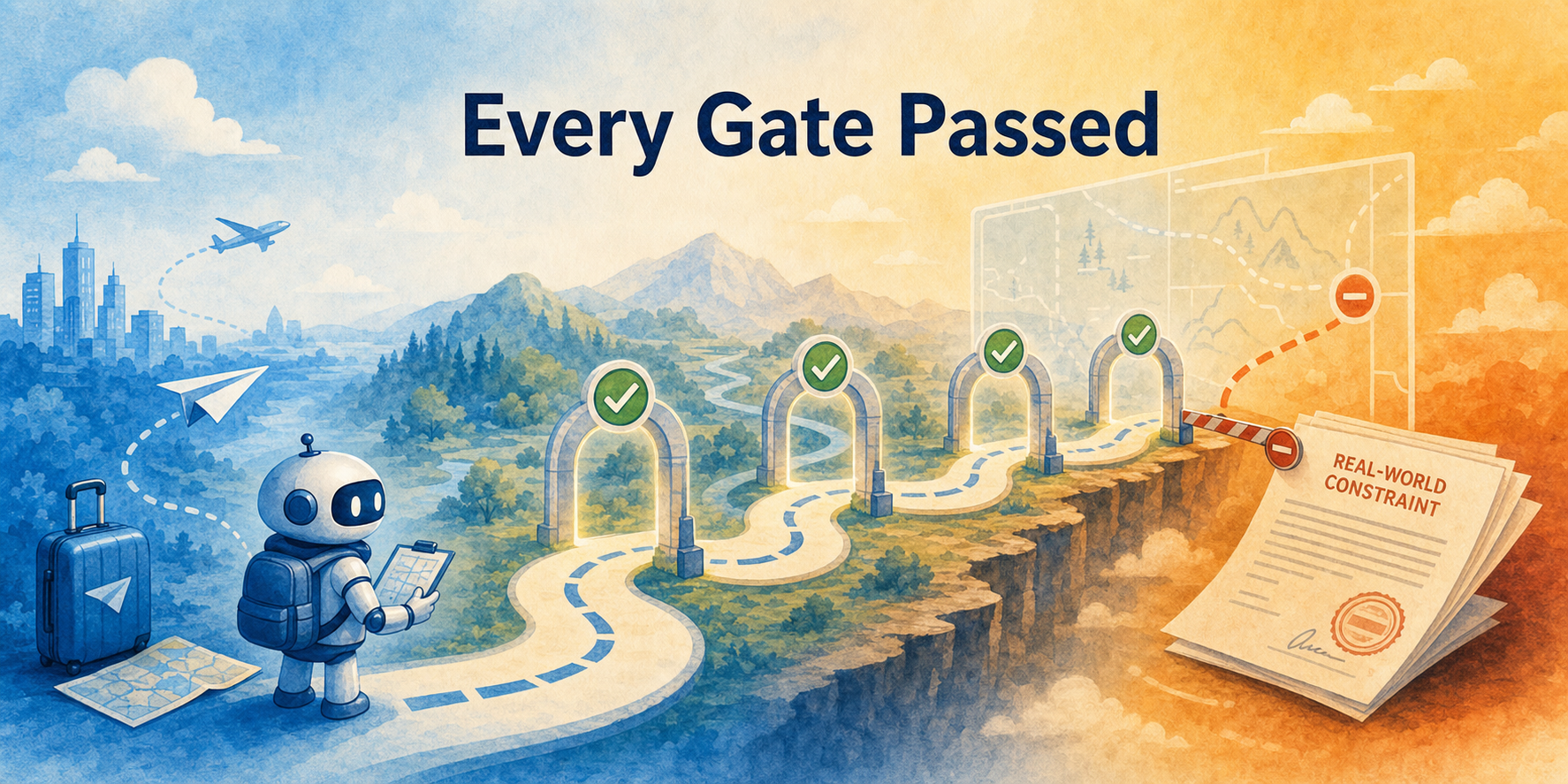
At one extreme, you require the human travel agent to approve every action Otto takes - every book, rebook, cancel, upgrade, monitor. This is the model most agentic-AI products start with, and it's also the one that quietly kills the product. Real-time review on every action is slow and theatrical. Worse, it creates what a 2024 Future Healthcare Journal paper called a "liability sink": the human nominally approves choices they can't realistically evaluate, and ends up bearing exposure for outcomes they didn't actually control. At the other extreme, you let Otto operate untouched and hope the firm absorbs the variance. That can work in low-stakes domains but not when consequences land on a third party - the traveler.
The right architecture, I've come to think, is insurance.
Otto is the field agent. The human travel agent is the underwriter. The firm behind both is the carrier. The traveler is the policyholder. The field agent executes within defined limits. The underwriter doesn't approve each action; they set the policy that defines what the field agent can do, price the discretion granted, and hold the reserves the carrier draws down when something goes wrong. The carrier provides the capital - the actual financial promise that makes the policyholder's recourse mechanical, not aspirational. The policyholder pays a premium for one specific thing: the guarantee that when the trip goes sideways, they are made whole without having to fight for it.
This isn't a metaphor borrowed for narrative convenience. It's where the AI governance literature is independently converging. Anat Lior's 2022 paper "Insuring AI" argued explicitly that insurance, not personhood, is how consequences get routed back to the humans behind AI agents. AIUC, a startup that emerged from stealth in mid-2025 with a $15M seed led by Nat Friedman, is building exactly this stack for enterprise AI. Christian Catalini and coauthors' 2026 working paper "Some Simple Economics of AGI" argues that as AI execution becomes abundant, the binding constraint on the economy is "human verification bandwidth" - the capacity to validate, audit, and underwrite AI outputs. The new scarce factor, in their language, is "the ability to insure outcomes rather than merely generate them."
Once you accept the insurance frame, two problems that looked separate collapse into one.
The first is consent. Policyholders don't pre-approve each insurance event; they sign a policy that defines what's covered, at what limits, with what deductibles. Otto's traveler should consent the same way - not transaction by transaction, but to a policy: pre-authorized auto-actions inside a budget envelope, escalation triggers for borderline cases, hard blocks at the edges. The human travel agent's job is to underwrite that policy thoughtfully given what they know about the traveler. Consent is real, meaningful, and informed - but it lives upstream of the actions, where consent lives in every insurance product that has ever worked.
The second is the human-in-the-loop question. The industry has spent two years debating whether per-action human review is necessary for high-stakes AI agents. Coding agents have already dropped it; medical and legal contexts are still arguing. Insurance answers it cleanly: per-action review is the field agent's job, and the field agent isn't human anymore. The human's review is at the underwriter's time horizon - aggregate quality, loss patterns, policy adjustments, post-incident repair. Filippo Santoni de Sio and Giulio Mecacci's 2021 paper distinguishes tracking (does the system respond to the right reasons?) from tracing (can you find a human in the chain with knowledge and standing to be answered to?). The underwriter does both, and neither requires gating every action.
The first-principles result that falls out is sharp. Otto's accuracy is no longer just an engineering metric. Each basis point of accuracy gain reduces required reserves, lowers needed review intensity, and expands the discretion the carrier can safely grant. The unit economics of the business become a direct function of measured AI quality. Or, to flip Itai Kolt's 2025 observation about why deterrence fails on AI agents - they don't value money or freedom - into a constructive form: the firm absorbs deterrence on the agent's behalf, and gets better at absorbing it as the agent becomes more measurable. This is also why aggregate human review isn't theater: it's how the carrier measures its loss curve. Without it you cannot underwrite, full stop.
There is precedent for this kind of move. The corporation was the first algorithm we built that worked without a body. We didn't make corporations safe by demanding they have skin; we made them safe by routing real consequences through them - courts, fiduciary duties, executives who can be prosecuted, shareholders who can be wiped out. AI agents are the second such algorithm, and the same trick is available again, this time routed through insurance machinery rather than corporate law.
There's also a re-org insight lurking in this frame. Right now "human travel agent" sounds like "the human who does what Otto does, just slower" - and the industry debate is whether they survive. The reframe says they don't survive doing that job. They survive doing the underwriter's job - a different function altogether: aggregate quality, policy setting, pricing discretion, holding reserves, showing up after a bad trip to make the policyholder whole. Pre-Otto, those functions existed but were buried inside the act of booking. Post-Otto, they separate out, and the human's value concentrates there. This is how headcount can go down without skin going down.
The accountability premium, then, does not get paid to whoever approves the action. It gets paid to whoever can credibly underwrite the outcome.
When AI handles execution, skin in the game lives where the reserves live. Otto's accuracy isn't an engineering metric - it's the firm's capital efficiency.
References for the reader who wants to follow up: Taleb, N. N. (2018). Skin in the Game. Random House. Matthias, A. (2004). "The responsibility gap." Ethics and Information Technology 6(3). Vallor, S. & Vierkant, T. (2024). "Find the Gap: AI, Responsible Agency and Vulnerability." Minds and Machines. Lior, A. (2022). "Insuring AI." Harvard Journal of Law & Technology 35(2). Catalini, C., Hui, X., & Wu, J. (2026). "Some Simple Economics of AGI." arXiv:2602.20946. Santoni de Sio, F. & Mecacci, G. (2021). "Four Responsibility Gaps with Artificial Intelligence." Philosophy & Technology 34. Kolt, N. (2025). "Governing AI Agents." arXiv:2501.07913. Lawton et al. (2024). "Clinicians risk becoming 'liability sinks' for artificial intelligence." Future Healthcare Journal.