Business Travel Must-Haves: The Ultimate Checklist
The complete business travel must-haves checklist for road warriors. Six categories of essentials, from carry-on gear to disruption prep, so every trip starts with the chaos already handled.


When you fly often, the scramble usually hits the night before: an early client presentation, a first flight out to get there, and a late-night hunt for your REAL ID while you try to remember which bag has the backup charger. Then you notice your noise-canceling headphones are nearly dead. The scramble is preventable.
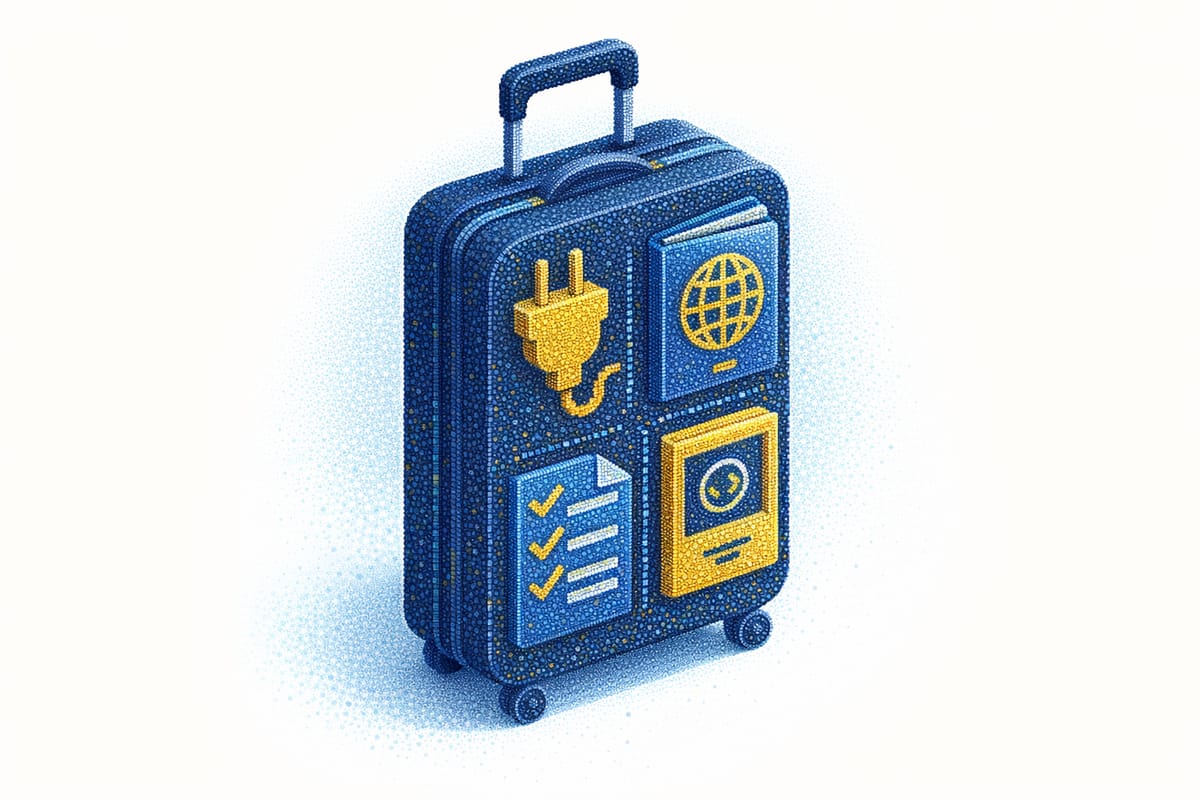
Frequent travelers dodge it by locking down six categories of business trip essentials before they leave: luggage, power, documents, booking details, disruption plans, and a permanent travel kit. Skip the last-minute chaos, and the only thing on your mind is the meeting at the other end.
Carry-On Luggage: The Right Bag Makes Every Airport Faster
Carry-on luggage wins for veteran business travelers because it saves time on both ends of a flight, can't get lost, and keeps your packing honest. Every checked bag adds time at the carousel each way, plus the risk of a delayed bag torpedoing a first-day client meeting. The mishandled baggage rate sounds small at 0.55% for 2024, but December 2024 spiked to 0.60%, and the 2024 airline range ran from 0.20 per 100 at Allegiant Air to 0.84 per 100 at American Airlines. Across the segments a road warrior flies per year, that risk adds up fast.
Your personal item should hold everything you need in flight: laptop, documents, chargers. If the overhead bins fill and you're forced to gate-check your carry-on, your personal item keeps critical business materials within reach. That matters most on basic economy, which may limit you to a single underseat item.
Tech and Power Essentials for Business Travel
A dead laptop mid-flight or a phone near zero during a ride from the airport costs you more time than any gear purchase. Treat these as mandatory.
- Laptop charger plus a verified backup cable. One cable failure shouldn't strand your work. Keep the backup in your personal item, never in checked luggage, since spare lithium batteries must stay in the cabin under cabin battery rules.
- High-capacity power bank. A bigger power bank gives you breathing room when outlets disappear or a hotel desk has one usable plug. Stay at 100 Wh or under, and keep it in the cabin if your carry-on gets gate-checked.
- Noise-canceling headphones. A flight with noise cancellation turns into productive time. A quality set blocks enough engine noise to actually focus.
- A confirmed data plan or hotspot. Hotel Wi-Fi fails at the worst moments. When it does, a phone hotspot means a video call from the room actually works.
Travel Documents and ID Requirements That Cause Delays
Most travelers handle documents fine on easy trips. The items below are the ones that trip you up on business trips specifically, where a screening delay or a missing line on a reservation costs you a meeting.
REAL ID, KTN, and Redress: Know What You Have and Where It Lives
As of the REAL ID deadline on May 7, 2025, every traveler 18 and older must show a REAL ID-compliant license or an acceptable alternative to board a domestic flight. That's the baseline, and TSA PreCheck membership doesn't get you a pass. Beyond it, your Known Traveler Number needs to be on every booking, including the ones you might forget. A KTN that isn't attached to a reservation means the regular line.
If the PreCheck indicator doesn't show on your boarding pass, follow the KTN verification steps to confirm the KTN, name, and date of birth all match on the reservation. Store your KTN somewhere it can populate every booking so it never goes missing. If you have a Redress Number from DHS, attach it to every reservation alongside your KTN to head off repeated screening delays.
Physical Backup of Your Hotel and Meeting Address
Phones die and apps crash, usually when you need them most. Screenshot your hotel confirmation, flight itinerary, and meeting address into your camera roll before you leave. Those screenshots work offline when cell service and hotel Wi-Fi don't.
Pre-Trip Booking Setup Most Business Travelers Skip
Pre-trip setup separates travelers who handle disruptions smoothly from those who scramble: loyalty numbers confirmed on every booking, preferences stored somewhere that remembers them, and a plan for when the first flight goes wrong. This is the part most booking tools skip entirely, and it's the gap that actually separates a clean trip from a chaotic one.
Start with the loyalty number problem, because it's the one most travelers just accept. Re-entering the same frequent flyer numbers and seat preferences every single trip is the core friction, and it's expensive when it fails. If a number is missing from a reservation at the time of travel, you can miss mileage credit on that flight. For hotels, a stay missing the loyalty number can cost you elite night credit. Retroactive fixes are manual and time-limited.
This is exactly what Otto the Agent handles up front. It stores your loyalty numbers and preferences and auto-attaches them to every booking you make through it. You don't re-enter them, and you don't check whether they populated. Set it up once, and every trip after that inherits it, so you cut the chance of missed-credit headaches caused by leaving the number off the reservation.
Flight Disruption Prep: What to Have Ready Before Delays Hit
Disruption prep lets you handle a delay with a quick text instead of an hour on hold. In 2024, on-time arrivals hit 78.10%, so plan on something going sideways. Have these in place before you leave.
- Flight-tracker app with push notifications on. It can warn you before the airport board updates. Turn notifications on at home, not at the gate.
- A backup flight identified before departure. Know which other carrier has a later option on your route. Spotting it ahead of time is enough.
- Your hotel's cancellation deadline noted. If a delay pushes your arrival past midnight, you want to know whether the property will release your room. Many hotels use free cancellation windows with a specific cutoff.
- Corporate card travel protection details saved. The Chase Sapphire Reserve reimburses up to $500 per ticket when your trip is delayed more than 6 hours. Know what yours covers before you need it.
Otto keeps working after you book. For eligible disruptions on flights booked through it, rebooking options can pop up in your conversation instead of making you go hunt for them. Pick the one that works, confirm, and it handles the rebooking. If you've already checked in, changes require direct carrier contact.
Travel Kit Essentials Frequent Flyers Keep Permanently Packed
The most time-efficient road warriors don't repack from scratch because they keep a dedicated kit that never gets unpacked between trips. Start with the items that create the most last-minute friction, then refill or replace them after each trip.
- A pre-stocked toiletry bag. Full-size items stay at home, while travel-size duplicates live permanently in the bag. Refill after each trip, and you never forget toothpaste again.
- Packing cubes. They speed up organized retrieval at the hotel, so unpacking doesn't turn into a search through the whole carry-on.
- A spare phone cable. Keep one in the laptop bag, because one dead cord shouldn't kill a workday.
- Business cards or a digital contact-sharing app. Conference introductions move faster when your contact details are ready.
- An empty water bottle. Carry one that clears TSA empty, then fill it past security.
Stop Packing Like Every Business Trip Is Your First
Once you've traveled enough, the gear on this list stops being a checklist and becomes automatic: the carry-on you keep packed, the backup cable you stop forgetting, the backup charger you never leave without. These habits matter because travelers who move through airports without friction have stopped starting from scratch every trip.
Otto brings that same permanent-kit logic to the part of the trip most tools leave you to handle alone: the booking layer underneath everything else. Sign up for Otto and start every trip with that layer already behind you.
Frequently Asked Questions About Business Travel Essentials
What's the single most important thing to have for a business trip?
A boarding pass and a valid REAL ID get you on the plane. But the item that separates smooth trips from chaotic ones is your power setup: a charged laptop, a full power bank, and your chargers in the right bag, not buried in checked luggage where you can't reach them.
Is it worth investing in noise-canceling headphones for business travel?
Yes, if you work during flights. A quality noise-canceling set turns flight time into productive hours and blocks enough engine noise to keep you focused.
Should I always carry on only for business trips?
Carry-on luggage saves time and takes the risk of lost bags off the table. Most business trips can be packed into a carry-on with a little wardrobe planning.
What documents should I have backed up before a business trip?
At minimum: hotel confirmation, flight itinerary, and meeting address. Screenshots in your camera roll work when the app or cell service doesn't.
How do I make sure my loyalty number is on every booking?
Most travelers enter it manually, miss it on some bookings, and lose the status credit. Store your loyalty numbers somewhere they auto-populate, and confirm they show up on the reservation before travel.