Travel Disruption Management for Travel Teams
Build your travel disruption management framework: policy, vendor requirements, communication, and readiness metrics.


Your CFO wants three numbers from last week's Northeast ground stop: travelers stranded, extra hotel spend, and rebooked-fare cost. Assembling the answer required forwarded confirmations, a card feed, and expense reports nobody had filed yet. The trips themselves recovered. The program's credibility didn't.
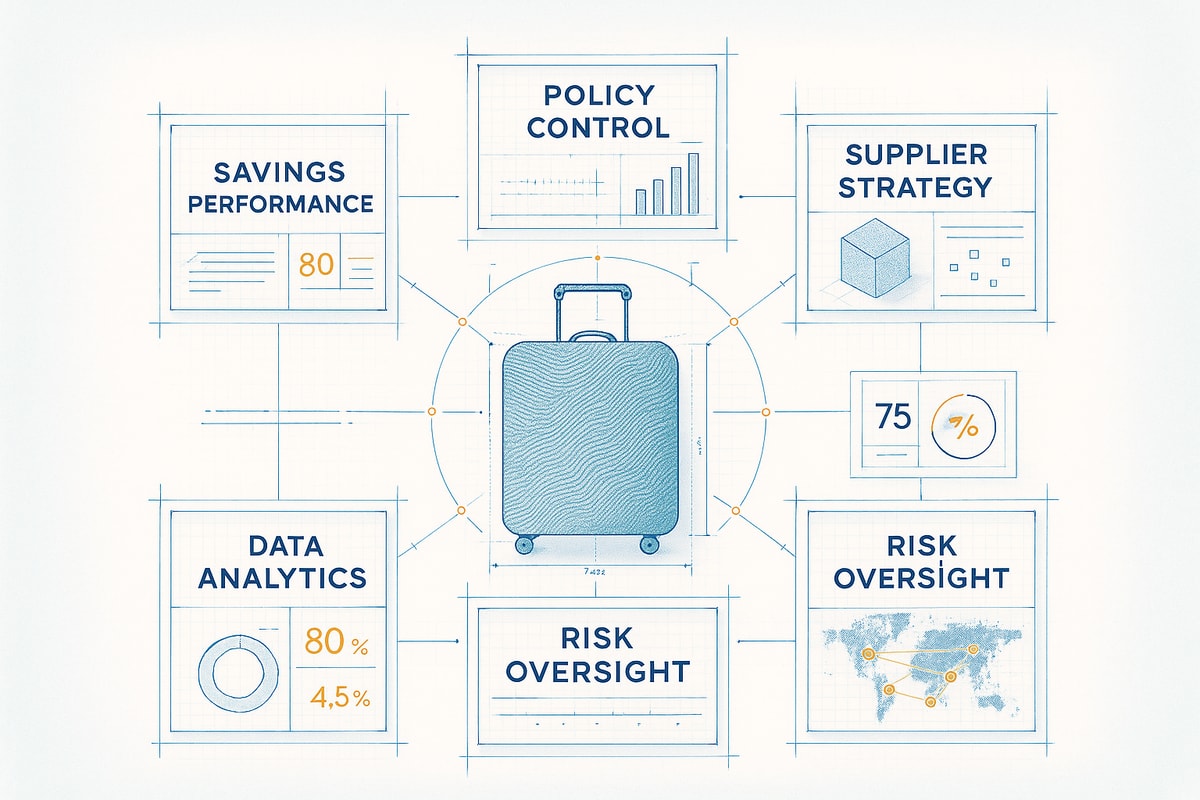
Travel disruption management at the program level answers those questions before leadership asks them. This framework has five components: disruption scope, policy provisions, vendor requirements, communication protocol, and readiness metrics. Build all five, and you can prove the program is ready before a disruption tests it for you.
What Travel Disruption Management Covers at the Program Level
A disruption is any event that moves cost or risk across the traveler population at once. It shows up as extra hotel and fare costs, plus hours of staff time spent tracking down who was affected, costs that rarely land in one line item finance can isolate.
That scope starts with cancellations, delays, schedule changes, and missed connections. Severe weather, strikes, geopolitical events, airspace closures, IT outages (the July 2024 CrowdStrike failure kept Delta canceling for five days), and public health events also hit many travelers at once. They trigger rebooking and unplanned spend while teams find out who is where.
Only 69.49% of U.S. flights arrived on time in the July 2026 on-time data, and the cancellation rate was 2.79%, compared with the 1.4% average for all of 2024. With that level of disruption, 55% of travel managers rate disruption management as a source of friction.
Building Disruption Response Into Travel Policy
Most policy documents only explain what happens when a trip goes as planned, so add three provisions: when refundable fares apply, who approves disruption spend up to what ceiling, and how companions and groups get rebooked. A disruption clause can be one sentence stating that when a cancellation, delay, or weather event outside the traveler's control strands a trip, the traveler may book lodging and meals up to the policy ceiling and rebook through the managed channel.
Flexible Fare Requirements
Specify when refundable fares are authorized, such as trips above a set dollar amount or domestic legs with tight connections. Events with a high probability of schedule change may also qualify. Pair that with a 7-to-14-day advance booking requirement, which captures lower fares and keeps the 24-hour cancellation window as a safety net.
Under the federal automatic refund rule, a traveler who declines the airline's alternative after a canceled flight or a significant change (more than 3 hours domestically, a different airport, added connections, or a cabin downgrade) gets a refund to the original form of payment within seven business days for card purchases. This applies regardless of fare type. Travelers should decline vouchers unless the program approves otherwise, so the money returns to the corporate card.
Authorization Thresholds During a Disruption
Set your own disruption spend ceiling and name an after-hours approver who can sign off at midnight. Within that ceiling, set lodging reimbursement at up to 300 percent of per diem, or up to 150 percent of the State Department rate with advance approval. Then apply that coverage to interruptions from flight cancellation or severe weather beyond the traveler's control, while excluding costs within the traveler's control. Build the ceiling into the budget assumptions finance already reviews, so a disruption month reads as a planned scenario instead of an unexplained overage.
The threshold matters more after October 19, 2026. A Department of Transportation rule effective that date reclassifies 10 delay causes as outside airline control, so airline dashboard commitments for hotels and meals no longer cover those events. When the airline doesn't pay, your policy decides whether the traveler or the company does.
Group and Companion Travel
Decide upfront whether companions can use the managed channel at all, and write it down before a disruption forces the call. That decision matters most for guest speakers, board members, interview candidates, and executive spouses, since their bookings often need manual workarounds that leave visibility gaps exactly when a disruption hits. If you'd rather avoid those gaps, bar companion bookings from the managed channel and make companion expenses non-reimbursable. For group itineraries specifically, name who rebooks and whether travelers stay together or split.
Vendor and TMC Requirements for Disruption Support
If you don't have a TMC yet, disruption support is where vendor quotes look identical and actual coverage doesn't. Get these commitments in writing before you sign, not after a bad night proves you needed them.
- Ask the TMC to state whether after-hours coverage is in-house or outsourced, where call centers sit, and how staffing changes during a declared mass-disruption event.
- Set separate speed-to-answer targets for standard hours, after-hours, and disruption events, with 80 percent of calls answered within 20 seconds as the floor and a 5 percent abandonment ceiling.
- Specify automated itinerary monitoring with proactive outreach, and ask for the average time from status change to traveler notification.
- Define the fare-difference amount agents may approve without escalation when rebooking, and require automatic application of airline waivers.
- Build in three response tiers (agent, duty manager, account manager or executive) with maximum response times at each level.
- Require event reporting with a traveler-count threshold that triggers a declared event, initial notice within 30 minutes, updates every 60 minutes, and a post-event summary within 24 to 48 hours.
- Ask for a real-time list of every traveler on a given flight or in a given city within 15 minutes of a request.
If you already have a TMC, run the same list against your current contract at renewal, not just at signing. The bar doesn't change based on company size or vendor tier.
Communication Protocol When Disruption Hits
Build an internal escalation path by naming one person or team to own disruption response, reachable around the clock and not just during business hours. The travel manager is often first-line contact; HR handles traveler well-being and family communication, and a security lead or senior executive owns crisis decisions. Write down names and backfills for each role, and refresh that roster at least annually with a tabletop drill.
Because a managed channel can report locations only for itineraries it holds, have it notify affected travelers first and the travel manager follow up with anyone missed. If no managed channel holds the booking, the travel manager notifies travelers from card feeds and forwarded confirmations. With each notification round, send finance and the executive sponsor a one-line status with traveler count, known exposure, and next update time.
Otto the Agent applies that same principle. It holds the itinerary for every flight, hotel, and rental-car booking it completes in Slack, Teams, or email, so it can flag an affected traveler the moment a monitored flight's status changes. Holding the itinerary gives a program without a full TMC the same starting point a vendor-held booking gives a managed channel. The protocol gets a traveler list it can actually notify, not a guess pieced together from card feeds after the fact. Otto's role stops at flagging a status change and holding the itinerary; the escalation path you named above still owns the judgment calls that follow.
Measuring Program Readiness
Calculate Readiness to Respond by dividing the travelers you hold location data on by total travelers out at any given time. After each event, use that ratio to check for gaps.
- Compare the event's Readiness to Respond ratio against baseline, and trace each missing traveler to the channel that lost them.
- Log response times, time to resolution, and the split between travelers contacted proactively and travelers who called in.
- Count the event's policy exceptions and unplanned spend against your authorization thresholds.
- Survey affected travelers.
Track every identified gap to closure with a named owner and a date. Most programs never test their disruption plan until a real event forces the test, so a documented review with closed items is the evidence a CFO actually wants to see.
Prove Travel Disruption Management Readiness Before It Gets Tested
Every component in this framework depends on bookings that exist in a managed channel before the trip starts. When bookings live on consumer sites and personal cards, nobody holds the itinerary, and the readiness ratio becomes a guess.
Otto books flights, hotels, and rental cars through that same managed channel, with confirmations and expense-ready receipts. It runs free for the first year, with no contracts, no agent-assist fees, and no minimum spend, so a program doesn't need a full TMC contract just to get that visibility.
Set up Otto to keep disruption bookings visible before the next event tests your readiness. Pair it with a risk provider when you need duty-of-care services such as traveler tracking or crisis response.
Frequently Asked Questions
How much does TMC disruption support cost?
TMC disruption support rarely appears as its own line item on a quote. Ask each vendor to break out what's included in the $70 average per-transaction fee, particularly after-hours coverage and rebooking authority, so you're comparing real protection and not just a headline number.
What's the difference between travel disruption management and travel risk management?
Travel disruption management handles the logistics of rebooking and cost recovery when a flight or hotel plan breaks. Travel risk management covers traveler safety and duty of care, including medical and security response, whether or not a booking is disrupted. The two overlap in a serious incident, but one policy rarely covers both.
Can you cancel a refundable hotel booking during a travel disruption?
Yes. A pay-at-property, fully refundable hotel booking can be canceled and rebooked without losing money, since nothing was charged before the stay happens. A prepaid, non-refundable rate saves money when plans hold, but it forces a credit or a dispute as soon as a disruption changes your dates.
How can a company without a TMC reduce off-channel bookings?
Off-channel bookings usually trace back to a managed option that's slower than a consumer site, more than to travelers ignoring policy. A lightweight TMC such as Otto lets travelers set a default payment method once and send booking requests by chat instead of filling out a form, cutting the friction that drives leakage.