Car Rental Without a Credit Card on Business Trips
What the rental counter checks when you pay by debit, and how to still get the car on a work trip.


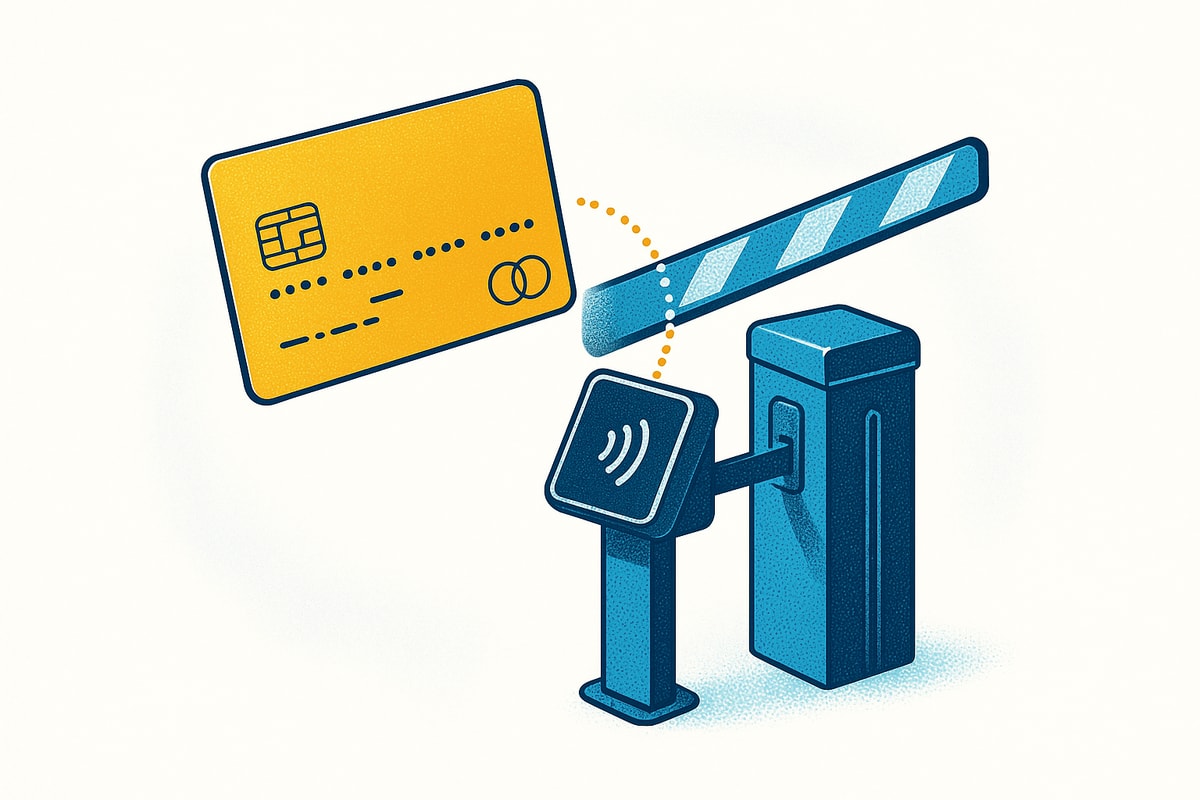
The flight landed on time, the shuttle dropped you at the counter, and your reservation is right there in the system. Then the agent asks for a credit card in the renter's name. The card your company issued carries the company's name, not yours. The debit card sitting behind it in your wallet triggers a set of rules nobody mentioned when you booked.
This guide covers the five things that decide whether you drive off the lot without a credit card, from what the counter actually verifies to the coverage gap that catches business renters specifically. You will know before pickup day whether your card qualifies, instead of finding out with a line behind you.
What the Rental Counter Is Actually Checking
The counter is not checking whether you can pay. It is checking whether it can still reach you for money nobody has counted yet, which means fuel, tolls, a citation, or damage assessed after you have flown home.
A credit card answers that question by reserving part of a credit line, and no cash moves unless those charges materialize. A debit card draws on money actually sitting in a checking account, so the brands treat it as a weaker guarantee and attach conditions to it. Avis names the function directly, calling the card at pickup credit identification, a separate test from the card that eventually pays the bill.
That split explains why the answers you find online contradict each other. Avis and Hertz both take a debit card as final payment when you drop the keys, including at locations and on vehicle classes where the same card would not have qualified you at pickup. Paying was never the question.
What Renting on a Debit Card Actually Requires
Most major US brands accept debit at most locations, and every one of them attaches conditions a credit card would have skipped.
- You have to clear a higher age floor, because Avis and Budget both set 25 for debit renters, with 18 in New York.
- The hold runs larger. Hertz debit terms authorize up to $500 on top of estimated rental charges, against $200 for a credit card rental in the same base vehicle classes.
- Some brands run a credit check at the counter and some do not. Hertz performs one on debit renters at most locations, while Dollar's debit policy rules a credit check out and holds $200 plus estimated charges instead.
- Two forms of identification are standard, and Hertz asks for both at airport locations along with proof of a return flight matching the rental dates.
- Your vehicle choice narrows. Hertz allows debit from economy through premium plus electric, and on compact and small SUVs only, which puts large SUVs and specialty cars out of reach. Avis requires a credit card outright for its Select Series and other premium vehicles.
- Prepaid and gift cards fail everywhere as credit identification, even where the brand accepts them for payment at return.
- Prepaid rates can close the door on their own, since Hertz does not accept debit on its Pay Now inventory at all. Nobody charges you a higher daily rate for paying by debit, so what you lose is access to prepaid inventory rather than money on the rate, which means you should price the trip against pay-later rates only.
The hold is also a cash-flow problem stacked on a qualification problem, because it lands in your personal checking account for a trip the company is paying for and sits there until your bank posts the release. Your reimbursement clock does not start until the expense report goes in, so the paperwork is the part you control. Otto the Agent stores an expense-ready PDF receipt for every booking automatically, which keeps the rental agreement from becoming the thing standing between you and your own money.
Why Your Company Card Usually Doesn't Solve This
A company card works at the counter only if it carries your name. Hertz states the requirement as a card in the renter's own name, and that name has to match the license you hand over with it.
That one rule takes out most of the payment methods a finance team hands travelers. A card issued in the company's name fails the match, and a virtual or single-use number has no physical card to present. The card belonging to whoever booked the trip fails too, and Avis closes that loop by refusing a reservation for another driver outright. Whoever reserved the car is who has to rent it.
Direct-bill and corporate-account arrangements are a partial fix. They settle the rate, which is a different transaction from the deposit, so a traveler on a corporate account can still be asked for a personal card to secure the hold. Confirm which one your account covers before you fly.
The Coverage Gap That Catches Business Renters
The rental coverage on a personal credit card and the coverage on a personal auto policy may not apply at all when the rental is for work. Business use is a common exclusion in both. A debit renter therefore gives up a card's collision damage waiver that likely would not have covered a work rental to begin with.
That leaves three places coverage can come from.
- The waiver sold at the counter covers damage to the rental itself, usually with no deductible, and liability is priced separately.
- Your employer may already carry coverage on business rentals, and HR is where you find out whether rentals are included and how to add them if they are not.
- A standalone policy fills the gap for travelers whose employer carries nothing and who hold no personal auto policy to fall back on.
Sort out which of the three applies before the trip, and check how your company expense policy treats a counter waiver, because buying one becomes a line item somebody has to approve. That decision has to be made before you sign the rental agreement.
How to Get the Car Anyway
Every move below happens before you reach the counter, because each one changes the reservation rather than the conversation at pickup. A qualification rule is set nationally and applied locally, and the agent in front of you has nothing to waive, which is why none of this works retroactively. Two of the four are deadline-driven and have to be settled the moment you book, and the other two depend on which branch and which colleague you choose. None of them requires getting a credit card.
Confirm the Rules for That Exact Location
Brand policy is a starting point and location policy is the answer. Some Avis locations decline debit at pickup for any vehicle, including branches in the Northern and Central New Jersey area and around Philadelphia, and licensee-owned locations set their own terms regardless of the national page. Call the pickup branch rather than the national reservation line. Qualification happens in person, so the brand's requirements apply no matter which app or site produced the reservation.
Book Off-Airport When the Trip Allows It
Off-airport branches skip the return-flight requirement that catches most debit renters at airports. Budget's airport locations can ask for a ticket or boarding pass plus proof of a return flight matching your rental dates, and Hertz asks for the same at its airport counters, while Hertz allows debit at the start of a rental at its corporate-owned Local Edition branches off airport. The trade-offs are real, since those branches keep shorter hours, after-hours return varies, and you are paying for a rideshare leg to reach the lot.
Give Yourself Enough Runway
Same-day walk-ups are where debit renters get turned away. Hertz requires the reservation at least 24 hours before pickup to qualify on debit, and Dollar applies the same window at its US corporate locations, with a fallback that swaps the lead time for a second form of ID and proof of a return travel ticket. Booking the car when you book the flight puts you inside that window without thinking about it, and Otto handles the car in the same conversation rather than leaving it as the errand you get to last.
Put the Cardholder on the Contract
If a colleague on the trip holds a qualifying card in their own name, let them rent the car and add you as an additional driver. Avis charges no additional driver fee for a boss or a fellow employee traveling on business, provided they are 25 or older and hold a current license. The mechanism matters, because this works by making the cardholder the renter, not by borrowing their card.
Know Whether Your Card Qualifies Before You Land
The card rule is a collection mechanism, not a judgment about your credit, and the branch applies it rather than the brand. That is why two locations of the same company can give you two different answers on the same card. Five minutes beforehand settles the one variable you cannot argue your way out of at the counter.
Otto holds the reservation and the changes in one place, so when a meeting moves, you ask for new dates in plain language instead of working a phone tree between sessions. What Otto cannot do is vouch for you at the counter. The card rule at the counter belongs to the rental brand, and the question of who keeps company-paid rental points belongs to your employer. Neither one gets decided by you at pickup, which is why both are worth settling in advance.
Let Otto handle the flight, the hotel, and the rental car so the only thing left to sort out before pickup is the card in your wallet.
Frequently Asked Questions
Can you rent a car with a debit card at an airport location?
Usually yes, with requirements a neighborhood branch would not impose. Airport counters commonly want proof of a ticketed return itinerary matching your rental dates plus a second form of identification. Airport counters treat that return ticket as the substitute for a credit line, since it is the evidence that the car is coming back.
How much does a rental car company hold on a debit card?
It depends on the brand, the location, and the vehicle class, and the figure sits on top of your estimated charges rather than inside them. Where the hold bites is the release, because the brand reverses it at return and your bank then decides how long the money stays unavailable. On a trip you are fronting personally, that timing matters more than the amount.
Does a company credit card work at the rental counter?
Only if your own name is on it and matches your license. A card imprinted with the company name alone fails, a virtual or single-use number has no card to present, and a colleague's card fails even with written permission. If your company issues cards centrally, ask whether a personally named card can be issued for travel, since that one change removes the problem permanently.
How do you keep a rental car reservation from falling apart when your trip dates move?
Change it before pickup rather than at the counter, since extending a rental in progress triggers a fresh authorization, and Budget adds a service fee plus up to three additional holds for an extension. For a rental booked through Otto, you ask for the new dates or a cancellation in plain language wherever you already work, including Slack, Microsoft Teams, or inside Claude and ChatGPT.
Is rental car insurance necessary on a business trip?
Often more necessary than on a personal trip, which is the opposite of what most travelers assume. Credit card collision benefits and personal auto policies commonly stop short of work travel, so the fallback you would rely on at home may not be there. Ask your employer which coverage applies before you sign, and treat the counter waiver as the default if nobody can answer.