Corporate Travel and Entertainment Policy: How to Set Rules for the Gray Areas Finance Hates
Build a corporate travel and entertainment policy that finance will actually enforce. Per-person meal caps, alcohol rules, gift limits, and approval tiers explained.


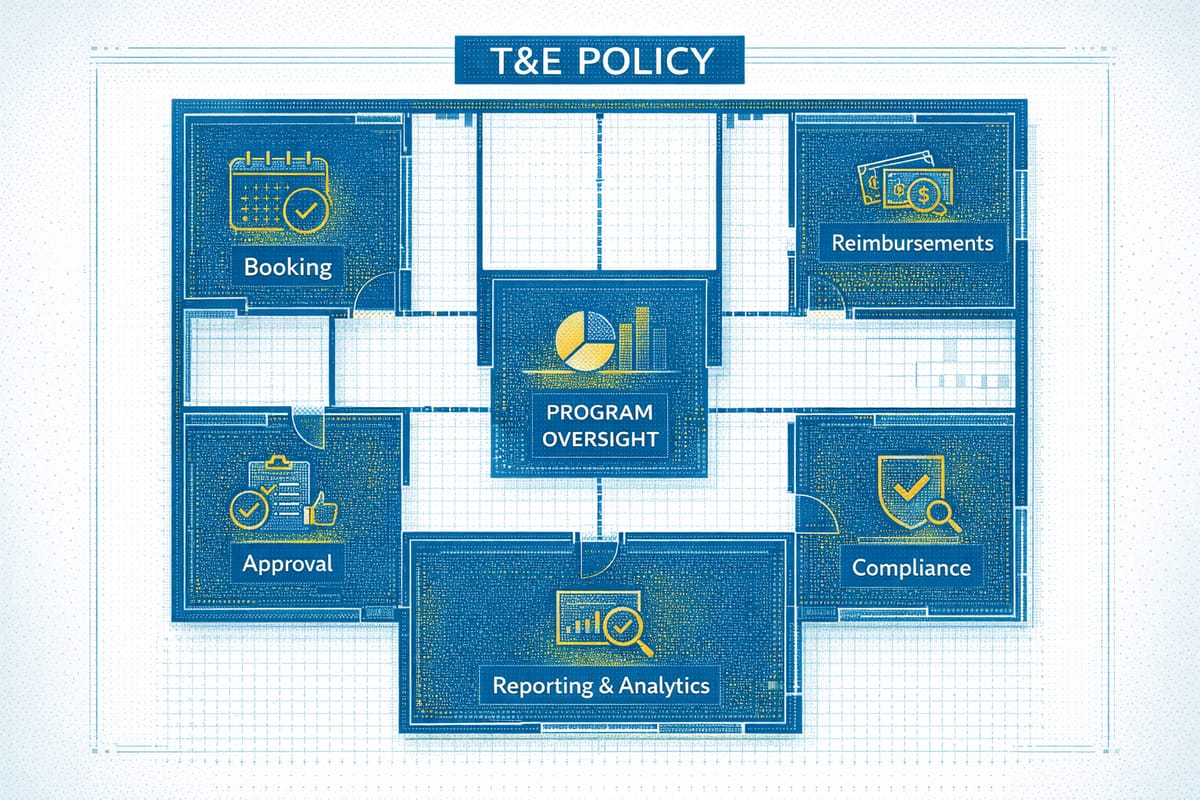
Finance flags several disputed expense reports from last quarter, including a client dinner and a team happy hour charged to a project code. Managers approved each expense at the time, but finance is now disputing them because the entertainment rules were not explicit enough. A strong corporate travel and entertainment policy handles flights and hotels cleanly, but entertainment spending is where the gray areas live and where most T&E policy disputes originate.
Corporate T&E guidelines need explicit rules for per-person meal caps, alcohol, gifts, tickets, and approval authority before finance reviews the expense report. Those rules give managers the same standard finance will use later, which keeps expense approvals from becoming reconciliation disputes.
Use Per-Person Caps for Client Meals
Cap client meals on a per-person basis. Per-person caps scale with group size and are easier to audit. Set your per-person rate by meal type, because a travel-day lunch and a client dinner belong in different categories. Set standard client dinners at $75–$100/person, with director approval required at $150/person for higher-stakes dinners.
Anchor those rates to the cities where you actually do business. For FY2026, GSA M&IE tiers run from $68/day for standard CONUS locations up to $92/day for the highest-cost cities such as New York and San Francisco. Even at the top tier, the dinner allocation only reaches $38/person, so treat GSA as a floor. At 56% of companies, meal spending limits and per diems stayed flat from the prior year, which means many caps drift out of step with current restaurant costs.
Alcohol is the most disputed line item in any meal expense, so the policy has to pick one approach and state it clearly. You have three options:
- Exclude alcohol entirely. Ends ambiguity but can clash with client norms.
- Bundle it into the per-person total. Hides alcohol spend inside the cap.
- Set a separate alcohol cap. A $25/person allowance tracks it precisely.
Whichever rule you choose, require itemized receipts so finance can audit the line item consistently.
Set Separate Rules for Internal Events and Team Spend
Offsites, team celebrations, all-hands dinners, and holiday parties are entertainment expenses, but most T&E policies ignore them or treat them as client entertainment. The tax delta alone justifies a separate category: employee-only holiday parties can be fully deductible when they're occasional and the whole team is invited, client meals stay at 50%, and general entertainment drops to zero. Three different deductibility outcomes sitting under one policy line is how internal spend ends up miscoded at reconciliation.
Separate team entertainment from client entertainment before employees submit expenses. Connect the cap, budget owner, approval level, and procurement path:
- Use a separate budget category for team events, charged to a department card rather than an individual reimbursement.
- Scale approval requirements with headcount and total cost, since a large offsite should not be approved on the same authority as a small lunch.
- Route events of more than 10 people through a separate procurement channel with a documented business purpose.
- Set a per-person cap for team meals distinct from client caps, for example, $25/person for infrequent employee-only meals.
Set Clear Rules for Gifts, Tickets, and Anti-Corruption Risk
Beyond meals, three other business entertainment categories carry sharper legal and tax consequences. Each needs its own rules because the compliance stakes escalate quickly.
Client Gifts
Set a per-gift dollar cap and a per-client annual cap, and require documentation of business purpose. The business gift deduction is capped at $25 per person per year, a figure unchanged since 1962, and indirect gifts count against that limit. Gift cards and gift certificates are taxable benefits, never excludable as a de minimis benefit no matter the amount. Prohibit cash equivalents in any amount.
Event Tickets
The classification turns on attendance. If a company representative attends with a client, the tickets are entertainment expenses and no longer deductible; if no representative attends, they may be treated as a business gift subject to the $25 limit. Track them separately and require pre-approval above a set threshold.
Anti-Corruption Boundaries
Government officials and regulated-industry contacts follow different rules, and dollar amount alone can't govern them. Anti-corruption law contains no minimum threshold for prohibited gifts, because the operative test is corrupt intent. Route all government official entertainment and foreign official entertainment to compliance review regardless of amount. In healthcare, Stark and Anti-Kickback rules add a separate framework requiring a legal-review carve-out even when no government official is involved.
Document Every Expense to Protect the Company
Documentation gaps drive most entertainment disputes, and most expense reports don't capture what finance needs. Frame each requirement as a field in the expense report so the traveler fills it in at the time of the expense:
- Itemized receipts. Documentary evidence rules apply to any expense of $75 or more. A charge slip shows payment only.
- Names and business relationships of all attendees. Name every attendee when 10 or fewer people are present.
- A stated business purpose. Contemporaneous records carry more weight, so require the purpose at submission.
- Approval above a threshold. Approval adds an audit-trail field even though tax substantiation rules do not require it.
- A rule for missing documentation. State plainly what happens when a receipt is missing.
Documentation on the travel side breaks down for a different reason: out-of-channel bookings. When travelers book flights and hotels on consumer sites, receipts scatter and managed spend visibility drops with adoption. For companies without a TMC, Otto the Agent works as a lightweight and free TMC that pulls flight and hotel bookings back into a managed channel, so finance sees the same clean documentation across the program.
Build an Approval Layer That Prevents Expense Disputes
Vague approval processes are where corporate entertainment policies quietly fail. The policy must specify who approves entertainment above the standard per-person cap and what documentation is required at the time of approval. A common tiered structure auto-approves routine expenses, requires manager approval in the middle band, and escalates larger amounts to a VP or finance lead. Approval timestamps before payment processing create the audit trail finance actually wants.
Executive self-approval creates a visible control risk, so the policy should state that an individual may not approve their own expense report. Use a one-level-up rule: when the authorized approver is hosting or being reimbursed for an event, the reporting manager must sign off. That closes the loophole where a senior executive hosts and approves the same dinner.
Bringing Your T&E Policy and Travel Controls Together
Corporate entertainment controls work best when they separate judgment-heavy spending from managed-channel travel spend. Client dinners, team meals, gifts, tickets, and event spend need policy guardrails at the approval moment. Flight and hotel spend needs a managed booking channel that keeps adoption high and unmanaged spend low.
For companies without a TMC, Otto gives a lightweight managed travel path without traditional TMC contracts, minimums, or implementation fees. Travelers book in the channels they already use and get expense-ready receipts back automatically, so finance sees consistent documentation across every trip. Otto is free to try with no contract or commitment, so the travel side of T&E stays managed while your entertainment policy controls the gray areas that require human approval.
Set up Otto to reduce travel leakage without adding traditional TMC overhead.
Frequently Asked Questions
What's the difference between a travel policy and a corporate T&E policy?
A corporate travel policy sets the rules for how employees book travel and how bookings flow through managed channels. A corporate travel and entertainment policy is the broader program document that also governs entertainment, gifts, alcohol, client meals, and the approval workflows that determine adoption and compliance.
Are client entertainment expenses tax deductible?
Generally no. Entertainment expenses are nondeductible under current rules. Business meals stay 50% deductible if an employee is present, the cost stays reasonable, and food is billed as separate line items.
How should companies set meal caps across different cities?
Use GSA M&IE tiers as a framework, then set actual per-person caps based on local market cost. For client dinners, that typically means $75–$150/person.
What documentation does the IRS require for business entertainment?
The IRS requires five elements: the amount, date, place, business purpose, and business relationship of everyone attending. Documentary evidence is required for expenses of $75 or more, and a credit card slip alone doesn't count.
How do growing companies reduce receipt gaps on the travel side of T&E?
Receipt gaps grow when managed travel adoption lags and bookings drift into unmanaged channels. For companies without a TMC, Otto keeps flight and hotel bookings in a managed path, so managed spend visibility and receipt data hold up before reconciliation.