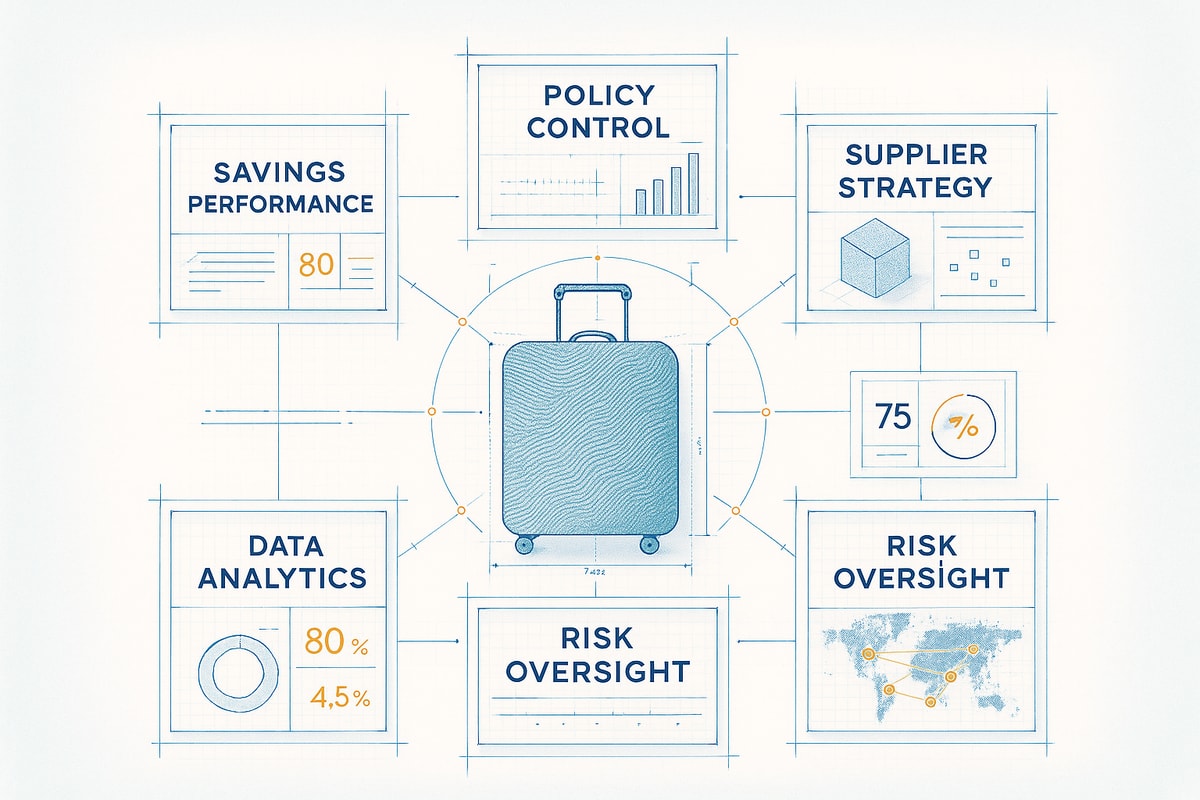
Global Corporate Travel Management for US-Based Programs
Which international gaps a US corporate travel program can close with policy, and which need a global TMC.


An account director lands in a country the program had no record of sending anyone to. The managed channel could not build the itinerary, so the trip got booked direct, and no one checked entry documentation against a lead time. The travel manager finds out from the expense report.
Global corporate travel management means holding one program together across borders: policy, booking channel, support coverage, and reporting. Cross-border trips change program accountability in four ways. This guide separates the gaps a US program can close with policy and a single booking channel from the capabilities that require a global travel management company (TMC), so international spend stays visible, and you can defend why no global agreement is signed yet.
What Changes When a Trip Crosses a Border
Only one of the four shifts is about price. Negotiated-rate coverage thins on long-haul routes, because airline discount tiers gate on committed volume by city pair and a handful of trips never reach the threshold a carrier prices against. Fewer than half of small and midsize programs even attempt a formal airline request for proposals, so most mid-market international travel already flies at public fares.
The other three shifts are operational, and they land regardless of what the program pays. Entry documentation acquires a lead time the program has to own, since routine passport processing runs 4 to 6 weeks plus up to two weeks of mail transit each way, and a missed document turns an approved trip into a write-off. Support coverage stretches to 24 hours, because a traveler hitting a disruption abroad needs help while the US office is closed. Reporting fragments once a card feed posts converted charges and hotel invoices carry value-added tax (VAT), so spend under management stops matching the ledger. An audit will find those three long before it finds a missed discount.
Why the Standard Global Playbook Does Not Fit Mid-Market
Consolidation buys almost nothing at mid-market volume, because there is nothing to consolidate. The standard global approach starts by consolidating regional TMCs, then picks a service delivery model, automates multi-currency handling and VAT reclaim at the point of purchase, and moves duty of care from reactive to predictive. Every step assumes regional volume and a vendor relationship in each market, run by someone whose full-time job is the travel program.
In a US mid-market program, international travel is a minority of trips concentrated in a few countries rather than spread across regions. One person reporting to finance runs the whole thing. The problem that playbook solves is real for companies that have it. 61% of buyers managing travel across regions call it a challenge, and 52% name juggling multiple TMC relationships among their top global program challenges. A program with one TMC and trips to four countries is not there yet, and buying the cure commits it to travel management company fees years early.
What You Can Handle Without a Global TMC
Four international gaps close with a written policy and one booking channel. Each is a documentation or capture problem rather than a buying problem, so the fix costs process time instead of contract commitments.
Entry Documentation and Lead Times as Policy
Passport validity rules differ by country, so require a check of the destination-specific page before every international trip. Those rules run past passports. Several destinations require an electronic travel authorization before boarding, so a corporate travel policy template should name who initiates visa applications and who completes the authorizations. For visa-required destinations, set a 90-day minimum lead time and require the traveler to carry the original passport.
One Booking Channel That Captures International Itineraries
Policy compliance breaks on international itineraries, where the online booking tool holds the least content. Nearly a third of companies using an OBT report that a fifth or more of travel spend gets booked outside the approved platform, and 53% of travel managers name missing content as the main driver. When the tool cannot build a multi-leg international itinerary, the traveler books direct, and no record exists.
A lightweight TMC closes the content gap by keeping complex itineraries inside the managed channel. Otto the Agent takes plain-language booking requests, checks entry requirements for the destination, searches global hotel inventory, and handles the multi-leg international flights that push travelers out of a portal. Travelers reach it from the iOS and Android app, from Slack, from Microsoft Teams, or from an MCP-compatible client such as Claude or ChatGPT, which matters when the person booking is eight time zones from the office.
Support Coverage Across Time Zones
A reactive rebooking desk covers the overnight window, and it costs far less than a risk program. A US employee hitting a long-haul misconnect at 3 a.m. Eastern needs a ticket reissued, which a servicing TMC does by phone. Threat monitoring and evacuation coordination come from an enterprise vendor instead, so price them separately rather than treating overnight coverage as duty-of-care compliance.
Currency Normalization at Reporting, Not at Booking
Reconcile monthly against the corporate card feed and treat the posted USD amount as the reporting value. Settlement-date rate timing explains the gap between what the traveler booked and what posts, so log it as foreign-exchange variance and leave the booking record alone. Multi-currency handling at booking time is an enterprise platform feature, and reporting does not require it.
What Genuinely Requires a Global TMC
Five capabilities have no policy or single-channel substitute. A program with a hard duty-of-care requirement on international trips should buy that capability from a vendor.
- Cross-border negotiated fares and consortium hotel rates. Consortium rates run on global distribution system (GDS) access codes held by member TMCs, and cross-border fare contracts sit with agencies that already carry the volume.
- In-market ticketing and reissue. Ticketing abroad runs on International Air Transport Association (IATA) accreditation and local Billing and Settlement Plan (BSP) participation, which ARC accreditation alone does not provide.
- VAT reclaim. Claims run per jurisdiction against local filing deadlines, and tax authorities often expect correspondence in the local language.
- Real-time traveler tracking and crisis response. Both run on dedicated travel risk infrastructure that a booking channel does not replace.
- Local ground handling and in-market servicing. A staffed desk in the destination market depends on local supplier contracts a US-based agency does not hold.
The first two capabilities determine whether a global TMC saves money. The rest determine whether the program can meet an obligation it has already taken on. Cost gets argued in the program review; the obligation surfaces after an incident.
The Volume Thresholds That Change the Answer
The global TMC decision is a measurement question, and four figures settle most of it. Start with international share of trips and of total spend, because those two numbers size policy work against sourcing work. Then look at concentration by city pair, which usually shows international volume spread too thin for any single carrier to care about.
The other two figures measure exposure instead of buying power. Count distinct countries, because servicing complexity scales with jurisdictions rather than with trip volume. Then measure the share of international trips booked outside the managed channel, which is the one figure a global agreement cannot move, since a contract only prices the trips that run through it.
Concentrated spend on a few long-haul routes is a sourcing conversation, and that is where TMC selection criteria start to matter. Spend scattered across a dozen countries at low volume is a policy and channel conversation instead. Fix the channel either way, because all four figures depend on data the channel produces. Otto is free for the first year, with no contracts, no agent-assist fees, and no minimum spend, so a program can capture international trips and build that data before committing to an annual global agreement.
Decide the Global Question With Your Own Trip Data
International trips leak because they stay invisible until reconciliation, and a program cannot argue either side of the global TMC question on data it does not have. The four figures decide it, and what they usually show is a thin sourcing case against an urgent capture case. That is the same order of operations a managed travel program follows domestically.
Otto gives a US program a booking channel that holds international itineraries and checks entry requirements before departure, which keeps international spend in the program record while volume stays under the sourcing threshold. Sourcing and duty of care still belong to a global TMC once the trip data supports the purchase.
Set up Otto to capture international trips in a managed channel while you build the case for a global agreement.
Frequently Asked Questions
What counts as duty of care without a risk vendor?
Documentation starts with a complete itinerary record for every international trip, which requires every trip to run through one channel. Add a published escalation path with a phone number that answers overnight and a named internal owner for international travel.
Should you source one route or the whole program?
Source the qualifying route and leave the rest alone. A repeated long-haul city pair is the only international volume a carrier will price against, and a deal on one route is a standalone negotiation rather than a commitment to move the program's remaining volume to that airline.
What if a trip is approved before the visa check?
Check the destination requirement first, then decide whether to move the trip rather than expedite the document. Expedited processing and courier fees often cost more than rescheduling, and a trip that departs without valid documentation becomes a full write-off.
How do you cover after-hours support for international travelers?
Overnight gaps push travelers toward unmanaged fixes, which cost the program the itinerary record and adds reconciliation work later. Otto covers that window with 24/7 phone support delivered through a partner TMC, so a traveler abroad reaches a live desk without the program staffing one.