What Is a Global Distribution System (GDS)?
The GDS network behind every TMC booking, and what it means for your program's cost and compliance.


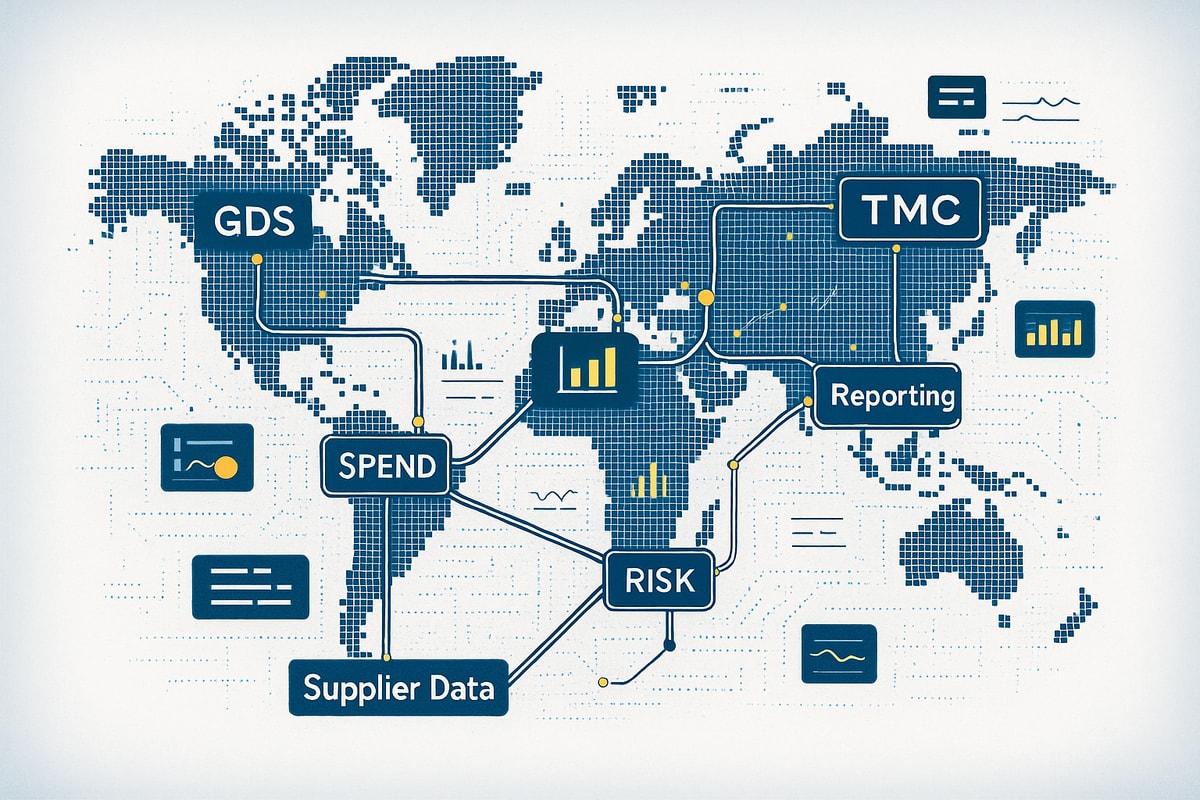
Your first proposal from a travel management company (TMC) lands with a per-transaction fee, a "content access" surcharge for certain airlines, and a footnote that pricing assumes bookings flow through the TMC's global distribution system (GDS). Nobody on the call explained what a GDS is, why it changes the number at the bottom of the quote, or why a competing bid priced the same volume differently.
This article covers five things: what a GDS actually does, who operates the major systems, how GDS economics set your per-transaction fee, what NDC changes about that model, and what to ask your TMC before you sign. By the end, you can read a vendor quote and know which line items trace back to GDS incentives.
What a Global Distribution System Is
A GDS is the back-end network that lets a TMC's agents and your online booking tool, or OBT, search, price, and book airline, hotel, and car content from one screen. Travelers never see it. Its customers are TMCs, online travel agencies (OTAs), and other travel businesses, and three companies run it: Amadeus, Sabre, and Travelport.
The GDS owns no inventory. Instead, each airline's reservation system holds its schedule and seat counts, while the GDS pulls that content from hundreds of carriers into one place. When a traveler books, the request goes through the GDS to the airline, which creates the reservation record (PNR). The TMC then handles ticketing, policy checks, and reporting. That means a booking made outside the GDS may not exist in the TMC's record unless it is transferred in as a passive segment.
After a request for proposal (RFP), hotels load negotiated rates against your company's GDS code, and the OBT pulls those rates for contracted properties. Similarly, car rental firms price off a corporate discount number entered in the GDS. If a rate loads wrong or a hotel never makes it available, your travelers see the wrong price in the tool.
The Major GDS Providers
Three companies run the systems US TMCs and OBTs connect to. Although all three serve that market, their corporate histories and system portfolios differ:
- Amadeus is the first of the three and serves US TMCs and OBTs.
- Alongside Amadeus, Sabre is another major provider based in Southlake, Texas.
- Travelport completes the group by operating the Galileo, Worldspan, and Apollo systems and has been privately held since 2018.
Despite those differences, which system your TMC uses matters less than the contract behind it. That contract matters because each GDS pays the TMC incentives on booking volume, even though GDS tools and usage are opaque to the buyer. This incentive becomes revenue on the TMC's side of the ledger and typically isn't itemized on your invoice.
How GDS Affects Your Fulfillment Costs
GDS economics set your per-transaction fee, even though the GDS never bills you. Airlines pay the GDS for every segment booked through it, and the GDS shares part of that payment with the TMC as a volume incentive. The TMC then bills you. As a result, about 71% of buyers pay transaction-based fees.
The TMC sets your per-transaction fee after estimating how much supplier income your bookings will generate. Most TMCs still earn more from airline, hotel, and GDS incentive payments than from what you pay them directly, so programs whose bookings generate little of that supplier revenue get quoted higher fees. Because NDC can reduce that income, some TMCs have told clients NDC bookings will carry higher fees to cover lost GDS incentives and reduced productivity.
To run a program, you need to see which bookings sit in policy and what each one costs. However, tracing GDS incentives through every booking to get there is unnecessary. When GDS economics make spend hard to reconcile, Otto the Agent is a standalone lightweight TMC that fulfills its own flight, hotel, and rental car bookings, shows whether options are within policy or out of policy with an explanation, and stores an expense-ready PDF receipt for each booking.
GDS vs. NDC: What's Changing
New Distribution Capability (NDC) is the airlines' alternative to EDIFACT (Electronic Data Interchange for Administration, Commerce, and Transport), the 1980s-era messaging standard GDSs still use. IATA introduced NDC in 2012 as an XML-based API standard for shopping, ordering, paying, and servicing airline products.
What NDC Carries That EDIFACT Cannot
NDC removes the 26-fare-class ceiling EDIFACT imposes on airlines, replacing it with continuous pricing that sets fares at any point between the old fixed classes. Airlines increasingly reserve continuously priced fares for direct and NDC channels, which is part of why the same seat can price differently depending on where you book it. NDC also carries ancillaries, bundles, and photos as they appear on the airline's own site, and it identifies the shopper, which opens the door to corporate-specific offers. Because of that gap, programs without NDC or direct access can see higher fares on continuously priced routes, and travelers who find lower fares outside the tool become leakage. However, TMC and OBT access to and servicing of those offers remain uneven.
Why Airlines Are Pushing It
Airlines want to stop paying GDS segment fees and to control their own offers. To force the issue, American removed a large share of its domestic fares from EDIFACT channels in April 2023, then partially backtracked about a year later. Others keep EDIFACT content but add NDC-only offers.
What It Means for TMC and OBT Content
Expect your TMC's GDS to carry NDC and EDIFACT content side by side for years, with fares shifting unevenly airline by airline. NDC was 6% of TMC bookings in 2024 and is expected to stay below 20% for a while. The adoption gap adds to that uncertainty: only 13% of buyers say their OBT supports self-service changes and cancellations on NDC bookings, and 37% make no NDC bookings at all.
What Travel Managers Should Ask Their TMC About GDS
Most buyers (81%) want more NDC information, and 50% say their TMC isn't sharing its plans. To close that information gap, use these questions to assess content coverage, servicing, economics, and data governance before signing:
- Start by asking which GDS the TMC uses and whether its NDC access depends on that system.
- Based on that answer, ask whether NDC fares can be booked under the same policy rules as EDIFACT content and changed or cancelled without an agent.
- Next, ask what the TMC earns on client bookings beyond the per-transaction fee, including GDS incentives, and whether NDC bookings will carry a higher fee.
- With those economics clear, ask whether commercial incentives shape which content appears in the booking tool and whether a client's content has ever been removed for revenue reasons.
- Finally, ask whether the TMC can deliver a complete data feed, including NDC bookings, and discuss the account data openly.
If the answers on revenue or data stay vague, an independent audit of content discrepancies in your tool is the backstop. That audit addresses content visibility, but disruption handling outside policy can create the same lack of control and let unmanaged rebooking produce more leakage.
To address that disruption risk for the flight bookings Otto fulfills, its workflow monitors each flight from booking and rebooks trips it controls, weighing options against the traveler's next calendar commitment, cost, and your travel policy. When the airline controls the reservation, Otto instead prepares a handoff to partner agents. This operating model supports policy compliance and reduces out-of-channel rebooking on trips Otto controls.
Decode GDS Costs Before You Sign a TMC Contract
You can now connect content-access surcharges and NDC fee differentials to lost GDS incentives instead of treating them as unexplained line items. In your next vendor meeting, ask which fees trace to those incentives and ask the TMC to show you the number. When those fees remain opaque, compare fulfillment models based on predictable booking costs and the ability to keep spend in one managed channel.
Otto addresses that cost-visibility problem for companies with or without an existing managed channel. Travelers use it in web, iOS and Android apps, and MCP-enabled experiences, plus Slack and Microsoft Teams. Travelers finish the booking directly in the same conversation they started it. That independence means Otto does not integrate with or layer onto another TMC, and companies whose current TMC meets their needs do not need to replace it. Managed booking coverage is free, with no annual minimum, agent-assist charges, or contract.
Start with Otto to keep fulfillment costs predictable without decoding GDS incentives.
Frequently Asked Questions
What's the difference between GDS and NDC?
A GDS is a distribution network that aggregates airline, hotel, and car content for TMCs and OBTs. NDC is a messaging standard letting airlines send richer offers, like continuous pricing and bundles, through APIs. Because GDSs now carry NDC offers, the practical question is whether your TMC can book and service them.
Do all travel management companies use a GDS?
The GDS model appears to remain the US norm, though no rule requires TMCs to use one. Most agency-airline relationships are expected to run mainly through a GDS in the near term, while some TMCs and OBTs add direct connects that widen content and change servicing rules airline by airline.
How do GDS fees affect corporate travel program costs?
GDS fees affect program costs indirectly through your TMC's pricing, not as a separate line item. TMCs set per-transaction fees based on expected supplier income, so two companies with identical travel volume can get very different quotes depending on their airline and hotel mix. Compare your quoted fee against transaction-cost benchmarks before you accept it.
How can travel managers get booking visibility without managing GDS relationships directly?
Without direct booking visibility, auditing distribution contracts becomes the only way to reconstruct policy status and spend. Otto addresses that gap by marking each flight, hotel, and rental car option with its policy status and an explanation, then automatically storing a PDF receipt ready for expense reporting after each booking.