The Best Sleeping Devices for Planes
The sleeping devices for planes that actually work, what security lets through, and the seat that beats them all.


You bought the neck pillow at a gate kiosk ten minutes before boarding an overnight flight, and it did nothing for the seat over the wing or the reading light two rows up that stayed on until landing. You woke six times. Then you walked into a 9 a.m. client session on ninety minutes of broken sleep.
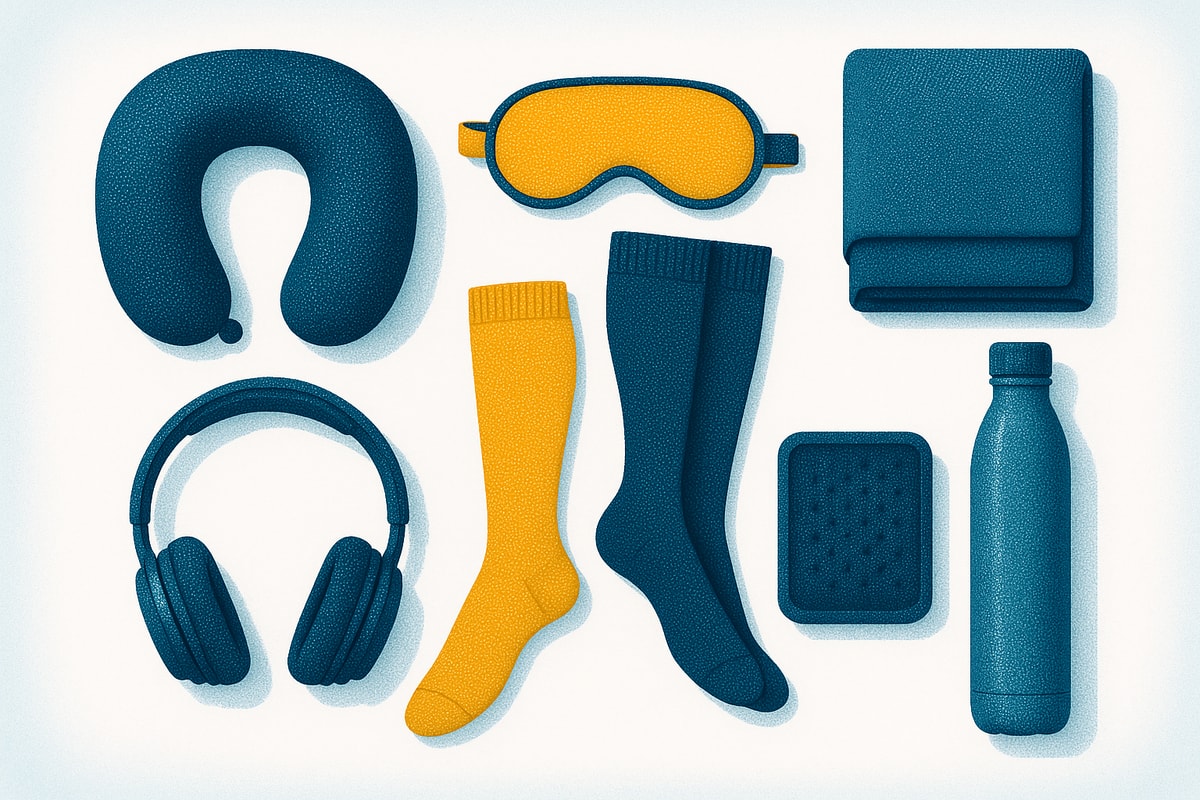
The devices that actually work are a contoured eye mask, foam or silicone earplugs, one head-support device matched to the seat you book, and a packable layer, in that order of return per ounce. Five categories produce those four items. Security and airline rules decide which ones make it onboard, a carry-on-only kit decides how many you carry, and the seat you book decides how hard any of them has to work. Get those right, and you land able to work.
Why Sleeping on a Plane Is Physically Hard
The cabin works against sleep on four fronts at once: noise, light, upright posture, and dry air. Each one sets a job for the gear you pack, so start with noise. Measured across five wide-body types, cruise noise levels stayed below 85 dB(A), with takeoff and landing the loudest stretches of the flight. Cruise noise then holds for hours, and announcements and cart service spike above it.
Light is the second front, and it does damage in doses. Higher light exposure in the hours before sleep lengthens sleep latency and pushes melatonin onset later. Seatback screens and a neighbor's open window shade both contribute, and neither one is yours to switch off.
Posture is the third. Sitting upright leaves your head unsupported, so it drops forward and pulls you awake each time. Cabin air is the fourth. Surveyed flights measured air temperature between 75 and 84°F and cabin humidity as low as 5%, and none of it is set by you.
You pay for all of it at 9 a.m., because sleep deficiency slows your reaction time and raises your error rate. Gear can only reach three of the four fronts. Blocking noise, blocking light, and stabilizing your head are solvable in a carry-on. Cabin air is not, which is worth knowing before you buy something that claims otherwise.
The Five Categories of Plane Sleeping Devices
Sleep gear gets sold by brand, but it gets chosen by category. Three of the five categories below take on the three problems gear can actually reach, and a comfort layer covers the one part of the cabin environment you do control. Those four are the kit, one device each and no more. Leg support, the fifth, handles circulation instead of sleep quality, which is why it is the first thing to leave home when space runs short. Within each category, the decision comes down to one variable, usually the seat you book or the way you sleep, so that is what each section below identifies.
Head and Neck Support
U-shaped foam pillows are the default, and they are the weakest option in the category. They limit forward head drop and do little else. Wraparound scarf-style supports hold the chin and both sides of the neck, and headrest straps anchor you at the forehead, so either one stops the drop that keeps waking you.
Your usual seat decides which one to buy. A window gives you a wall for the sideways lean, so forward drop is the only problem left. An aisle or middle seat gives you nothing to lean against, and only the wraparound or the strap holds your head where you put it.
Light Blocking
Masks come flat or contoured, and the difference matters more than the price. Flat masks press fabric directly against your eyelids, which turns strap tension into a trade-off. Loose enough to be comfortable leaks light at the nose bridge, and tight enough to seal presses on your eyes.
Contoured masks raise molded cups over each eye, so nothing presses on your eyelids and the seal holds without tightening the strap. The nose bridge is still the weak point on most designs, so check that seal before a flight where the cabin never fully darkens.
Noise Blocking
Active noise cancellation and earplugs solve different halves of the problem. Cancellation works on the low-frequency engine drone that runs the length of the flight, while foam and silicone earplugs work on announcements and service noise. That second half does the waking. Discrete noise events drive sleep fragmentation even when total sleep time holds steady, and continuous masking sound reduces the effect.
Form factor decides the rest. Side sleepers cannot wear over-ear headphones against a seat, which leaves earplugs or sleep-specific earbuds as the only workable overnight option.
Leg and Foot Support
Tray-table foot hammocks and inflatable footrests raise your legs so blood stops pooling and swelling drops. How much lift you get depends on tray-table height and your leg length, and it matters most on the long-haul segments where swelling builds. This is also the category most likely to be taken off you, which the next section covers.
Temperature and Comfort Layers
The crew sets cabin temperature, and nobody can do anything about the dry air, so a packable blanket or a wearable layer is the only lever you hold. It costs almost nothing, and it works in either direction, since you can put it on when the cabin runs cool and shove it behind your back when it does not.
More warmth means more bulk, though. A layer thin enough to live in the pouch year-round holds less heat than the one you actually want, so pick something you can wear rather than one more object to carry.
What Security and the Airlines Actually Allow
Three different authorities govern what you can carry, and only one of them is predictable. The FAA sets battery rules, TSA sets liquid limits, and individual carriers set their own restrictions on anything that attaches to or extends a seat. The first two apply identically on every flight you take. The third varies by airline and gets enforced at crew discretion, which is why the same footrest travels fine on one carrier and gets taken off you on the next.
- Spare batteries and power banks for battery-powered sleep devices are carry-on only, and their terminals need protection against short circuits under FAA battery rules. If the airline gate-checks your bag, every spare battery and power bank has to come out and stay with you in the cabin.
- Pillow sprays and gel eye masks fall under the TSA liquids rule, which caps containers at 3.4 ounces inside a single quart-size bag.
- Leg support carries the most risk. Delta's prohibited items list names foot hammocks, inflatable wedges, and knee defenders, and several other US carriers restrict anything that attaches to or extends a seat. Crews make the final call, so check your carrier before packing one.
- Crew checks that seatbelts are fastened whenever the sign is on, so keeping the buckle over your blanket rather than under it saves you being woken to prove it.
- Crew can also ask you to take off noise-canceling headphones for announcements and safety briefings, which is another reason earplugs are the lower-friction overnight choice.
Build the kit on the assumption that you may have to stow part of it. TSA's searchable item database covers anything else you are unsure about before you zip the bag.
Build a Sleep Kit That Fits Under the Seat
Four items cover everything gear can reach and still fit an under-seat personal item, which is the whole constraint when you travel carry-on only. Head support is almost always the bulkiest piece of sleep gear in the bag, while a mask and earplugs weigh nothing and solve two problems outright. Most travelers spend their space backwards.
Selection comes down to problem solved per ounce, and that math produces the same list almost every time. Nothing below is redundant:
- A contoured eye mask that seals at the nose bridge
- Foam or silicone earplugs, plus a spare pair
- One head-support device matched to the seat you usually book
- A packable layer for the back half of the flight
On short segments, the layer goes first, and leg support stays home, but the mask and earplugs travel every time. Keep all four in one pouch that lives in your carry-on, separate from the rest of your packing list, so the kit is aboard when a day flight runs long, and you end up sleeping anyway.
The Booking Decisions That Beat Any Device
No pillow compensates for a seat in the last row next to the lavatory. Your position in the cabin is decided at booking, and it determines how much work your gear has to do. Engine placement comes first, and seats forward of the wing sit ahead of the engines rather than beside or behind them. Galleys and lavatories matter just as much, because those zones carry light and foot traffic through the whole night.
Window versus aisle is the next call, and it comes down to what you can lean on. A window gives you a wall, so a simpler head support works. An aisle costs you that wall and puts you next to cart and passenger traffic all night. Aircraft type matters less than most travelers assume. Across five wide-body types, the measured spread was within 3 dB, so choosing your seat beats choosing your airframe.
None of this carries over on its own, and re-entering the same travel preferences on every trip is why most travelers stop making these calls after a few bookings. Otto the Agent learns your seat and cabin preferences and applies them across one-way, round-trip, and multi-leg itineraries, and you can book from Slack, Teams, or inside Claude or ChatGPT through an MCP connector instead of logging into a portal. Your sleep-relevant choices get made on every booking without you thinking about them, though no tool can guarantee a specific seat.
What to Re-Check When Your Seat Assignment Changes
Aircraft swaps, schedule changes, and involuntary reseating undo that booking work, usually through a notification you never opened. Airlines reassign by row and letter, not by position, so you can keep 12A on paper and lose every reason you picked it. Confirm the assignment survived, then check the two things that actually determined your choice:
- Whether your row moved relative to the galley or lavatory
- Whether the aircraft type changed, since a swap resets the cabin layout you picked around
There is an upside case too. On fully refundable fares, a higher fare class on the same flight sometimes gets cheaper after you book, and that is the cheapest route to a better sleeping position.
Otto keeps working after you book. On fully refundable flight reservations booked through Otto, it watches prices and alerts you when a drop brings a higher fare class into policy range, then cancels the original and rebooks once you confirm. Basic economy and other non-refundable fares are not tracked, so on the fares that qualify, you are not the one running ticket price tracking on the side.
Sleep Is a Booking Decision, Not a Shopping Decision
The right mask and the right earplugs are the highest-return items in any carry-on, and they cost less than the pillow you bought at the gate. But noise, light, posture, and dry air are mostly settled before you board, by where you sit and what you are flying on. That gap shows up worst on red-eye flights, where no amount of gear buys you out of a bad seat assignment.
Otto is what keeps that from being a decision you make well once and then stop making. Your seat and cabin preferences carry across bookings, so the row you sleep in stops depending on how much attention you had left at the time of booking. On eligible refundable reservations, Otto flags a better fare class on the same flight when the price drops into range.
Set up Otto to keep your sleep-relevant seat choices working across every overnight and long-haul booking, so you arrive able to do the work you flew out for.
Frequently Asked Questions
Do neck pillows actually help on a plane?
Neck pillows help only when the shape matches how your head moves in an upright seat. Test it in a straight-backed chair before you fly, and if your chin still drops or the support pushes your head forward, the design will not solve the wake-up that matters.
Can I bring a portable white noise machine on a plane?
A portable white noise machine can travel in your carry-on, but it costs more space and battery planning than passive earplugs. It makes sense when steady sound already works for you and the device earns the room in an under-seat kit.
Can I combine noise-canceling headphones with earplugs?
Combining the two covers both the engine drone and the sharper cabin sounds that break sleep. Test the combination for pressure and comfort before you rely on it overnight, especially if the headphones press against the headrest when you lean.
How can I keep my sleep-friendly seat preferences consistent across bookings?
Preferences follow the profile, not the channel, so the seat rules you set once apply whether the booking starts in Slack, in Teams, in the Otto app, or inside Claude through an MCP connector. That matters if you book from your laptop on some trips and your phone on others, which is usually where seat choices quietly get dropped.